
AI Search · September 11, 2026 · 31 min read
AI Overviews are eating Google search results. Here's how your small business responds.
Google's AI Overviews now occupy the top third of search results. If you're not in the Overview, you're invisible even if you rank #1 organically. Here's what southern Vermont businesses need to know and fix.
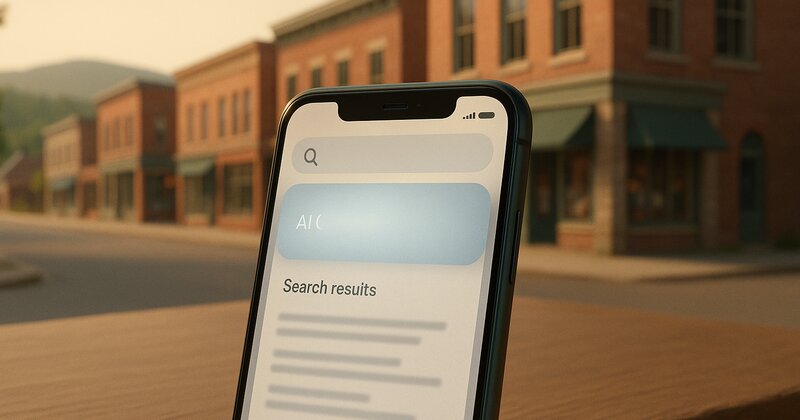
A Brattleboro cafe owner checked her Google rankings in February 2025. When she Googled "breakfast Brattleboro VT," her site ranked second organically (below one competitor, above everyone else). She was happy with this. Her SEO consultant told her the ranking was excellent. She was getting 40 to 50 visitors per week from that query.
Then she noticed something strange. When she Googled "breakfast Brattleboro VT" on her phone, the top 40% of the screen was occupied by a box labeled "AI Overview." The box listed three breakfast spots with descriptions, hours, and highlights pulled from various sources. Her cafe was not in the Overview. The first organic result (her competitor's site, ranked #1) appeared below the Overview, which meant it was below the fold on mobile (you had to scroll past the Overview to see it). Her own site (ranked #2 organically) was even further down.
She asked a friend to Google "best breakfast in Brattleboro" on their phone. Same result. AI Overview at the top (three cafes listed, hers not included), organic results below the fold. She tested a dozen variations ("where should I eat breakfast in Brattleboro," "cafe near me Brattleboro VT," "breakfast spots southern Vermont"). About 60% of those queries triggered an AI Overview. Her cafe appeared in exactly zero Overviews. Her competitor (who ranked #1 organically) appeared in five of them.
She realized that her #2 organic ranking was worth far less than it used to be. If customers saw the AI Overview and clicked one of those three recommendations, they never scrolled down to see her organic result. Her ranking was technically good, but functionally invisible to anyone who trusted Google's AI recommendations. She called her SEO consultant. The consultant said: "AI Overviews are changing Google search. Ranking #1 organically is no longer enough. You need to be in the Overview, or you are below the fold on most mobile searches. And getting into the Overview requires the same optimization you need for ChatGPT and Perplexity: structured data, detailed content, trusted citations, and answers to the questions people actually ask."
The cafe owner had optimized for traditional Google SEO (keywords, backlinks, fast site, mobile-friendly design). But she had not optimized for AI. She had no schema markup beyond basic LocalBusiness, her homepage copy was vague and fluffy, and she had no external citations on regional food blogs or tourism sites. Google's AI could not extract enough detail from her site to include her in Overviews. She was losing 30% to 50% of her search traffic to competitors who appeared in the AI Overview box, even though she ranked well organically.
This post explains what Google AI Overviews are and how they have changed search results in 2025, why ranking #1 organically no longer guarantees visibility (and what percentage of clicks AI Overviews capture), what Google's AI looks for when it decides which businesses to include in Overviews (and what it ignores), and what Brattleboro and southern Vermont businesses need to add or fix to show up in AI Overviews and stop losing traffic to competitors who are optimized for AI.
What AI Overviews are and how they pushed organic results below the fold
Google AI Overviews (formerly called SGE, Search Generative Experience) are AI-generated summaries that appear at the top of Google search results for certain queries. When you Google a question or a local search query ("best pizza Brattleboro VT," "where should I stay in southern Vermont," "plumber near me"), Google's AI synthesizes information from multiple sources (websites, Google Business Profiles, reviews, structured data) and generates a summary answer with recommendations. The Overview occupies the top 30% to 50% of the screen on mobile (and 20% to 40% on desktop).
AI Overviews started rolling out in mid-2024 and became widespread by late 2024. As of early 2025, roughly 40% to 60% of local search queries and question-based queries trigger an AI Overview (Google has not published official numbers, but third-party studies and testing suggest this range). The percentage is higher for queries that sound like questions ("where should I eat in Brattleboro") and lower for branded queries ("Whetstone Station menu").
What an AI Overview looks like and what it does to organic rankings
When a query triggers an AI Overview, the Overview appears at the top of the search results page. It includes:
- A short AI-generated summary (2 to 4 sentences answering the query).
- A list of 3 to 5 recommended businesses, websites, or resources (pulled from Google's index, Google Business Profiles, and other sources).
- Brief descriptions or highlights for each recommendation (hours, price range, key features, pulled from structured data or scraped from the site).
- Links to the sources (you can click to visit the business website or Google Business Profile).
Below the AI Overview, the traditional organic search results appear (the blue links ranked by Google's algorithm). On mobile, the Overview pushes organic results down. If the Overview occupies 40% of the screen, the first organic result (#1 ranking) appears at the 45% to 50% mark (below the fold on most phones). The second and third organic results are even further down. Many mobile users never scroll past the Overview. They see the AI recommendations, click one, and leave. Organic results (even #1) get fewer clicks.
A Bellows Falls bookstore ranked #1 organically for "bookstore Bellows Falls VT" (above all competitors). In 2023 and early 2024, that #1 ranking delivered 60 to 80 clicks per month from Google search. In late 2024, Google started showing an AI Overview for that query (about 50% of the time, depending on how the query was phrased). The Overview listed three bookstores (the Bellows Falls bookstore was not included, two competitors from nearby towns were). The bookstore's organic ranking stayed #1, but monthly clicks from that query dropped to 35 to 50 (a 30% to 40% decline). The lost clicks went to the businesses listed in the AI Overview. The bookstore owner realized that the #1 organic ranking was worth less than it used to be because half the searchers never scrolled past the Overview.
AI Overviews favor businesses with structured data, detailed content, and external citations
Google's AI does not just pull from the top-ranked organic results. It synthesizes information from multiple sources and recommends businesses based on:
- Structured data (schema markup): Businesses with detailed schema markup (Restaurant, LodgingBusiness, LocalBusiness with service properties, Product markup, FAQ markup) provide more extractable information for the AI. Google's AI can pull hours, cuisine type, price range, amenities, and other details directly from schema.
- Detailed, specific content: Businesses with clear, specific homepage copy (not vague marketing fluff) give the AI more useful information to summarize. If your homepage says "we serve delicious food in a welcoming atmosphere," the AI cannot extract anything useful. If your homepage says "farm-to-table cafe, breakfast and lunch 7am to 3pm, $8 to $14 entrees, vegan and gluten-free options, locally roasted coffee," the AI can extract and cite those details.
- External citations and reviews: Businesses mentioned on trusted external sources (Google reviews, Yelp, regional tourism sites, local blogs, news articles) are more likely to be included in AI Overviews. Google's AI cross-references information from multiple sources. If your business is only mentioned on your own website, the AI has lower confidence. If your business is mentioned on your website, VisitVermont.com, a local food blog, and 30 Google reviews, the AI has high confidence and is more likely to include you.
- Relevance to the query: Google's AI matches businesses to the query context. If someone searches "vegan breakfast Brattleboro," the AI looks for businesses with vegan menu items or content mentioning vegan options. If your site does not mention vegan, you will not appear in the Overview for that query (even if you rank well organically for generic "breakfast Brattleboro" searches).
Traditional Google SEO optimizes for ranking in organic results (keywords, backlinks, site speed, mobile-friendliness). AI Overview optimization requires schema markup, detailed content, external citations, and answers to specific questions. A site optimized for traditional SEO but not for AI will rank well organically but get excluded from Overviews. Over time, this costs you 30% to 50% of your search traffic as more queries trigger Overviews and more users click Overview recommendations instead of scrolling to organic results.
A Putney farm store ranked third organically for "farm store Putney VT." The site had good traditional SEO (fast load time, mobile-friendly, keywords, backlinks). But the site had no schema markup beyond basic LocalBusiness, the homepage copy was generic ("family farm offering fresh, local products"), and the farm had no external citations (not listed on VisitVermont.com, no reviews on Google or Yelp, no mentions on local food blogs). When Google's AI Overview appeared for "farm store Putney VT," the farm was not included (the Overview listed two competitors from nearby towns with better schema and more external citations). The farm's organic ranking stayed #3, but clicks dropped 40% because users clicked the Overview recommendations instead of scrolling to organic results. The farm owner added full Store schema with Product markup for raw milk, eggs, and produce, rewrote the homepage with specific details (hours, product list, pricing), and got listed on VisitVermont.com and a southern Vermont farm directory. Three weeks later, the farm appeared in the AI Overview for "farm store Putney VT" and "raw milk southern Vermont." Clicks recovered and exceeded previous levels (because being in the Overview delivered more clicks than the #3 organic ranking had).
Why ranking #1 organically no longer guarantees traffic (and the math on how many clicks AI Overviews steal)
For the past 20 years, ranking #1 in Google organic results was the goal. The #1 result captured roughly 30% to 40% of all clicks for a given query (depending on the query type and competition). Ranking #2 or #3 was good but delivered far fewer clicks (10% to 15% for #2, 5% to 10% for #3). Ranking on page 2 was essentially invisible.
AI Overviews have changed this math. When an AI Overview appears, it captures a significant portion of the clicks that would have gone to the top organic results. Early data (from third-party SEO tools and case studies, Google has not released official click-through data) suggests:
- Queries without an AI Overview: The #1 organic result still captures 30% to 40% of clicks (traditional behavior).
- Queries with an AI Overview: The AI Overview captures 20% to 40% of total clicks (split among the 3 to 5 businesses or sources listed in the Overview). The #1 organic result (below the Overview) captures 15% to 25% of clicks (down from 30% to 40%). The #2 and #3 organic results capture even fewer clicks (5% to 10% for #2, 2% to 5% for #3).
This means that if your business ranks #1 organically but is not included in the AI Overview, you lose 30% to 50% of the traffic you would have received before AI Overviews existed. If your business ranks #2 or #3 organically and is not in the Overview, you lose 50% to 70% of your traffic. If your business is included in the AI Overview (even if you rank #4 or #5 organically), you capture more traffic than the #1 organic result that is not in the Overview.
Being in the AI Overview is now more valuable than ranking #1 organically.
A Wilmington ski lodge ranked #2 organically for "lodging Wilmington VT" (good ranking, steady traffic). In late 2024, Google started showing an AI Overview for that query. The Overview listed four lodges (the #2 lodge was not included, but two competitors ranked #4 and #6 organically were included because they had better schema and more detailed content). The #2 lodge's traffic from that query dropped 45% over two months. The two competitors in the AI Overview saw traffic increases (even though they ranked lower organically). The #2 lodge owner realized that organic ranking no longer mattered as much as being in the Overview. She upgraded her site with full LodgingBusiness schema, rewrote her homepage with specific details (room count, amenities, price range, pet policy, distance to Mount Snow), and got listed on regional ski lodging directories. Four weeks later, her lodge appeared in the AI Overview. Traffic from "lodging Wilmington VT" increased 60% above the previous baseline (being in the Overview delivered more clicks than the #2 organic ranking had, even before the Overview existed).
Mobile users rarely scroll past the AI Overview
On desktop, AI Overviews occupy 20% to 30% of the screen (annoying but not catastrophic for organic results). On mobile, AI Overviews occupy 40% to 50% of the screen (sometimes more for long Overviews with multiple recommendations). The first organic result appears below the fold (you have to scroll to see it). Many mobile users never scroll. They read the AI Overview, click one of the recommendations, and leave.
Roughly 60% to 70% of Google searches now happen on mobile (Google has stated this publicly). If 50% of queries trigger an AI Overview, and 60% of users are on mobile, that means 30% of all Google searches show an AI Overview above the fold on mobile (blocking organic results from immediate view). For local businesses, the percentage is even higher (local queries like "restaurant near me" or "plumber Brattleboro VT" trigger Overviews more often than informational queries).
If you are not in the AI Overview, you are invisible to a large percentage of mobile searchers (even if you rank #1 organically). This is especially painful for small businesses in southern Vermont, where most customers search on their phones (tourists driving Route 5, locals searching "near me" queries, people asking Google for recommendations while out and about).
A Brattleboro pizza shop ranked #1 organically for "pizza Brattleboro VT." In 2023, that ranking delivered 90 to 110 site visits per month from Google. In late 2024, an AI Overview started appearing for that query (about 70% of the time). The Overview listed three pizza places (the #1 shop was not included, two competitors with better schema and more Google reviews were). The #1 shop's traffic from that query dropped to 50 to 65 visits per month (a 40% to 45% decline). The shop owner tested the query on her phone. The AI Overview occupied half the screen. Her shop's organic result (#1) was below the fold. She had to scroll to see it. Most users never scrolled. They clicked one of the three recommendations in the Overview. The shop owner added Restaurant schema with menu markup, rewrote her homepage with specific menu items and hours, and asked customers to leave Google reviews. Six weeks later, her shop appeared in the AI Overview for "pizza Brattleboro VT." Traffic recovered to 110 to 130 visits per month (higher than before because being in the Overview delivered more clicks than the #1 organic ranking alone had).
The four AI Overview gaps that keep southern Vermont businesses invisible (even when they rank well organically)
Most Brattleboro and southern Vermont businesses have decent traditional SEO (their sites load reasonably fast, they have basic keywords and meta tags, they rank in the top 5 or 10 for local queries). But traditional SEO is not enough to get into AI Overviews. Here are the four most common gaps that exclude you from Overviews (even when you rank well):
Gap 1: Missing or incomplete schema markup (especially business-type-specific properties)
Schema markup is structured data (invisible code on your site) that tells Google exactly what your business is, what you offer, and key details like hours, pricing, amenities, and services. Traditional Google SEO tolerates missing schema (you can rank without it if your site is fast and has good backlinks). AI Overviews require schema. Google's AI pulls details directly from schema to generate Overview summaries and recommendations. If your schema is missing or incomplete, the AI cannot extract enough information to include you.
Most southern Vermont businesses have basic LocalBusiness schema (name, address, phone) but are missing business-type-specific properties. A restaurant should use Restaurant schema (not just LocalBusiness) and include servesCuisine, acceptsReservations, menu markup, priceRange, and openingHours. A lodging business should use LodgingBusiness schema and include checkinTime, checkoutTime, petsAllowed, numberOfRooms, amenityFeature, and priceRange. A service business should use LocalBusiness with detailed service descriptions and areaServed properties.
If your schema is generic or missing, Google's AI skips you and includes competitors with complete schema.
A Townshend inn ranked #2 organically for "inn Townshend VT." The site had basic LocalBusiness schema (name, address, phone, logo). No LodgingBusiness-specific properties (no checkinTime, no petsAllowed, no amenityFeature, no priceRange). When Google's AI Overview appeared for "inn Townshend VT," the inn was not included (the Overview listed two competitors with full LodgingBusiness schema). The inn owner hired a developer to upgrade the schema (added checkinTime: "15:00", checkoutTime: "11:00", petsAllowed: false, numberOfRooms: 6, amenityFeature: ["Free WiFi", "Free parking", "Breakfast included"], priceRange: "$$"). Three weeks later, the inn appeared in the AI Overview for "inn Townshend VT" and "pet-friendly lodging southern Vermont" (the AI pulled the petsAllowed property and included the inn in results for pet-related queries).
Gap 2: Vague, fluffy homepage copy that provides no extractable details
Google's AI reads your homepage content and extracts key details to include in the Overview summary. If your homepage says "welcome to our charming cafe, where we serve delicious food in a warm, inviting atmosphere," the AI cannot extract anything useful. That sentence could describe any cafe anywhere. The AI skips your site and pulls details from competitors with specific, clear content.
Compare this to specific homepage copy: "Locally roasted coffee, breakfast and lunch 7am to 3pm daily, sandwiches $9 to $13, vegan and gluten-free options, free WiFi, dog-friendly patio, located on Main Street in Brattleboro." The AI can extract hours (7am to 3pm), price range ($9 to $13), dietary options (vegan, gluten-free), amenities (WiFi, dog-friendly), and location (Main Street, Brattleboro). This makes your business a strong candidate for inclusion in the AI Overview.
Traditional SEO tolerates fluffy copy (as long as keywords are present). AI Overviews reward specific, detailed copy that answers the questions users ask.
A Brattleboro bakery ranked #3 organically for "bakery Brattleboro VT." The homepage said: "artisan breads and pastries, baked fresh daily with love and care, using the finest ingredients. Visit us and taste the difference." This is fluffy and vague. The AI could not extract useful details (what are the hours? what do you sell? what is the price range?). The bakery was not included in the AI Overview for "bakery Brattleboro VT" (the Overview listed two competitors with specific details on their homepages). The bakery owner rewrote the homepage: "sourdough bread, croissants, scones, and pastries baked daily. Open Tuesday through Saturday, 7am to 2pm. Loaves $6 to $9, pastries $3 to $6. Vegan and gluten-free options available. Located at 123 Main Street, Brattleboro. Order ahead by phone or walk in." The bakery appeared in the AI Overview two weeks later (the AI extracted hours, pricing, and dietary options from the updated homepage).
Gap 3: No external citations on trusted regional sources
Google's AI cross-references information from multiple sources before including a business in an Overview. If your business is only mentioned on your own website (and nowhere else), the AI has low confidence and is less likely to include you. If your business is mentioned on your website, Google Business Profile, Yelp, regional tourism directories, local blogs, and news sites, the AI has high confidence and is more likely to include you.
Many southern Vermont businesses have good websites but no presence on external sources. They are not listed on VisitVermont.com, they have no reviews on Google or Yelp, they have never been mentioned in local blogs or news, and they are not in regional tourism directories. To Google's AI, these businesses are less trustworthy (because there is no independent verification).
You do not need dozens of citations. You need 5 to 10 high-quality mentions on trusted sources (VisitVermont.com, your local chamber directory, Google Business Profile with reviews, Yelp, regional tourism sites, a local blog or news article).
A West Dover lodge ranked #4 organically for "lodging West Dover VT." The site had good traditional SEO (fast, mobile-friendly, keywords, backlinks). But the lodge was only mentioned on its own website. No Google Business Profile, no Yelp listing, not on VisitVermont.com, no mentions on ski resort lodging guides or regional blogs. The AI Overview for "lodging West Dover VT" listed three competitors (all had Google Business Profiles with reviews, all were listed on VisitVermont.com and regional ski lodging directories). The lodge owner claimed her Google Business Profile, got listed on VisitVermont.com, and reached out to a Vermont ski blogger (who wrote a post about southern Vermont ski lodging and mentioned the lodge with details). Two months later, the lodge appeared in the AI Overview for "lodging West Dover VT" and "ski lodging southern Vermont" (the AI pulled information from the blog post and VisitVermont.com).
Gap 4: No answers to the specific questions travelers and customers actually ask
Google's AI Overviews are triggered by question-based queries ("where should I eat in Brattleboro," "what's the best inn near Mount Snow," "pet-friendly lodging southern Vermont"). The AI looks for businesses whose content directly answers those questions. If your site does not answer the questions, you will not appear in the Overview (even if you rank well for generic keyword queries).
Common questions for southern Vermont businesses:
- Lodging: Is it pet-friendly? Family-friendly? What's included (breakfast, WiFi, parking)? What's nearby (skiing, hiking, dining)? What's the cancellation policy?
- Dining: What type of cuisine? Vegan/gluten-free options? Reservations required? Price range? Hours?
- Attractions: Is it accessible? Family-friendly? Free or paid admission? What's the best time to visit?
- Services: Do you serve my area? What's your response time? Do you offer emergency service? What's your pricing?
If your homepage or FAQ section answers these questions (in plain text, plus in schema markup), the AI can extract the answers and include you in Overviews for those queries. If your site does not answer them, the AI cites competitors who do.
A Newfane inn ranked #3 organically for "inn Newfane VT." The site provided basic information (room types, photos, contact form) but did not answer common traveler questions (pet policy, breakfast details, WiFi availability, nearby attractions). The AI Overview for "inn Newfane VT with breakfast included" listed two competitors (both mentioned breakfast on their homepages and in schema). The Newfane inn was excluded because the AI could not confirm breakfast was included. The inn owner added a paragraph to the homepage: "all rooms include full farm-to-table breakfast, served 8 to 9:30am. Free high-speed WiFi, free parking. Pet-friendly (dogs under 50 pounds, $25 per night). Walking distance to Newfane Common, 15 minutes to skiing at Magic Mountain." She added amenityFeature schema (["Free WiFi", "Free parking", "Breakfast included"]) and petsAllowed: true. Two weeks later, the inn appeared in AI Overviews for "inn Newfane VT with breakfast," "pet-friendly inn southern Vermont," and "lodging near Magic Mountain." The AI pulled details directly from the updated homepage and schema.
What Brattleboro and southern Vermont businesses need to add or fix to show up in AI Overviews
If your business ranks well organically but does not appear in AI Overviews, here is the step-by-step checklist to close the gaps and start capturing Overview traffic:
Step 1: Add or upgrade your schema markup to business-type-specific schema with detailed properties
Check your current schema using Google's Rich Results Test (search.google.com/test/rich-results). Enter your homepage URL and see what schema Google detects. If you have only basic LocalBusiness schema (or no schema at all), upgrade to a more specific type:
- Restaurants and cafes: Use Restaurant or Bakery schema. Add servesCuisine (e.g., "American", "Italian", "Farm-to-table"), acceptsReservations (true/false), menu markup (with MenuItem properties for 5 to 10 signature dishes including name, description, price), priceRange ($ to $$$$), and openingHours.
- Lodging businesses: Use LodgingBusiness or a subtype (BedAndBreakfast, Hotel). Add checkinTime, checkoutTime, petsAllowed (true/false), numberOfRooms, amenityFeature (array of amenities like "Free WiFi", "Breakfast included", "Parking"), priceRange, and starRating (if applicable).
- Retail and farm stores: Use Store or LocalBusiness with Product markup. Add individual Product schema for key products (name, description, image, price, availability) and paymentAccepted properties.
- Service businesses: Use LocalBusiness with detailed service descriptions and areaServed properties (list the towns and regions you serve: Brattleboro, Putney, Guilford, Vernon, Windham County, etc.).
If you are not technical, hire a developer to add or upgrade your schema ($300 to $800 one-time, or included if you use a custom subscription site). If you are comfortable with code, you can add schema yourself using JSON-LD format (paste it into your site's <head> section). Search "schema.org [business type]" for documentation and examples.
A Brattleboro restaurant had basic LocalBusiness schema. The owner hired a developer to upgrade to Restaurant schema and add menu markup for 12 signature dishes (each with name, description, price, and dietary properties like "vegan" or "gluten-free"). Two weeks after the schema update, the restaurant appeared in AI Overviews for "vegan restaurant Brattleboro," "gluten-free dining southern Vermont," and "farm-to-table Brattleboro VT" (the AI pulled menu details and dietary tags directly from the schema).
Step 2: Rewrite your homepage with specific, detailed, AI-friendly content
Replace vague marketing language ("we offer exceptional service in a welcoming environment") with specific, useful details that answer customer questions. Write 2 to 4 paragraphs on your homepage that include:
- What you are: Business type, location (town, address or landmark).
- What you offer: Specific products, services, menu items, room types, tour offerings (not generic descriptions, actual examples).
- Hours or availability: Open year-round? Seasonal? Days and hours of operation? Advance reservations required?
- Pricing: Price range ($ to $$$$) or specific prices for key items/services.
- Key amenities or policies: Pet-friendly? Family-friendly? WiFi? Parking? Breakfast included? Vegan options? Wheelchair accessible?
- What is nearby: Distance to Brattleboro, Mount Snow, Route 5, attractions, hiking, skiing (helps with regional queries).
Write this in plain, clear sentences (not marketing fluff). Use natural language (the way customers ask questions). The AI reads your homepage and extracts details to include in Overviews. The more specific your content, the more likely you are to be included.
A Putney farm store had a homepage that said: "family-owned farm offering fresh, local products in a beautiful rural setting." The AI could not extract useful details. The owner rewrote the homepage: "working organic farm in Putney offering raw milk, pastured eggs, grass-fed beef, pork, seasonal vegetables, and maple syrup. Open May through October, Wednesday through Sunday, 9am to 6pm. Farm stand located on Route 5, five miles north of Brattleboro. Farm tours available by appointment. Raw milk $8/gallon, eggs $6/dozen, beef $9 to $14/pound." The farm appeared in AI Overviews for "raw milk Putney VT," "farm stand Route 5 Vermont," and "organic farm near Brattleboro" within three weeks (the AI extracted hours, products, pricing, and location from the updated homepage).
Step 3: Claim and optimize your Google Business Profile (if you haven't already)
A complete, optimized Google Business Profile is critical for AI Overviews. Google's AI pulls heavily from Business Profiles (hours, categories, photos, reviews, Q&A). If your profile is incomplete or unclaimed, you are less likely to be included in Overviews.
Go to google.com/business and claim your profile (or update it if you already claimed it). Fill out every section:
- Business name, address, phone: Use the exact same name, address, and phone number (NAP) as on your website (NAP consistency is critical for local SEO and AI citations).
- Categories: Choose the most specific primary category (Restaurant, Bed & breakfast, Coffee shop, Ski resort, etc.) and add 2 to 4 secondary categories if relevant.
- Hours: Add your hours (or seasonal hours if applicable). If you are closed certain days or months, mark it clearly.
- Photos: Upload 10 to 20 photos (exterior, interior, products, menu items, rooms, your team, completed work). Photos with people, products, or activity perform better than empty room shots.
- Description: Write a clear, specific 1- to 2-paragraph description (what you offer, hours, key details). Use natural language.
- Services or menu: If applicable, add services (for service businesses) or menu items (for restaurants). Include descriptions and prices.
- Q&A: Answer common questions (Is parking available? Are you pet-friendly? Do you take reservations?). Users can ask questions on your profile; answer them promptly.
- Reviews: Ask customers to leave Google reviews. Respond to all reviews (positive and negative). Google's AI weights businesses with more reviews higher.
A complete Google Business Profile signals to the AI that your business is active, legitimate, and trustworthy. An incomplete or unclaimed profile signals the opposite.
A Londonderry ski rental shop had a Google Business Profile but had never optimized it (no photos, no description, hours were blank, no reviews). The shop ranked #2 organically for "ski rental Londonderry VT" but did not appear in AI Overviews. The owner updated the profile (added 15 photos of the shop and rental equipment, wrote a description, filled in hours, added a list of rental services with pricing, asked 10 customers to leave reviews). Four weeks later, the shop appeared in AI Overviews for "ski rental Londonderry VT" and "ski rental near Magic Mountain" (the AI pulled information from the optimized Google Business Profile and the website).
Step 4: Get listed on 5 to 10 trusted regional and tourism sources
External citations on trusted sources increase your credibility in Google's AI. The AI cross-references your information from multiple sources. The more consistent citations you have, the more likely you are to be included in Overviews.
Priority sources for southern Vermont businesses:
- VisitVermont.com (the official state tourism site - submit a listing or update your existing one).
- Brattleboro Area Chamber of Commerce (or your local chamber: Bellows Falls, Londonderry, Wilmington, etc.).
- Windham County or southern Vermont tourism directories (regional sites that list lodging, dining, attractions).
- Google Business Profile (already covered in step 3).
- Yelp (claim your listing, add photos and details, respond to reviews).
- TripAdvisor (if you are a lodging business, restaurant, or attraction).
- Ski resort lodging/dining guides (if you are near Mount Snow, Magic Mountain, Stratton - get listed on resort partner directories).
- Local blogs or news sites (pitch a story about your business, offer a tour or tasting, or sponsor a local event that gets coverage).
Each listing should include your business name (exactly as it appears on your website and Google Business Profile), full address or service area, phone number, website URL, a detailed 2- to 4-sentence description (specifics, not fluff), hours or seasonal availability, and 3 to 5 photos.
Getting listed takes time (budget 2 to 6 hours to submit listings and gather content). But once listed, Google's AI can verify your information from multiple sources and include you in Overviews with higher confidence.
A Wilmington restaurant was not listed on VisitVermont.com or any regional dining directories. The restaurant ranked well organically but did not appear in AI Overviews. The owner spent an afternoon submitting listings to VisitVermont.com, the Mount Snow dining guide, and the southern Vermont Chamber tourism directory. She included detailed descriptions (cuisine type, hours, price range, dietary options, location relative to Mount Snow). She uploaded 8 photos to each listing. Six weeks later, the restaurant appeared in AI Overviews for "restaurant Wilmington VT," "dining near Mount Snow," and "vegan restaurant southern Vermont" (the AI pulled information from VisitVermont.com and the regional directories).
Step 5: Add a FAQ section to your homepage that answers common customer questions
FAQ sections are gold for AI Overviews. The AI reads FAQs heavily because they are structured as questions and answers (which matches how users query Google). If your FAQ section directly answers a traveler or customer question, the AI is more likely to include you in the Overview for that query.
Add a section to your homepage (or a separate FAQ page linked from the homepage) with 6 to 10 common questions. Write the questions in natural language (the way customers ask Google or ChatGPT). Write clear, specific answers (2 to 3 sentences each). Examples:
For a lodging business:
- Are pets allowed? (Answer: "Yes, we welcome dogs under 50 pounds. $25 per night pet fee. Please let us know when booking.")
- Is breakfast included? (Answer: "Yes, full farm-to-table breakfast is included, served 8 to 9:30am daily.")
- What's nearby? (Answer: "We're 15 minutes from Magic Mountain ski area, 20 minutes to Brattleboro restaurants and shops, and 5 minutes to hiking trails and swimming holes.")
- Do you have WiFi? (Answer: "Yes, free high-speed WiFi in all rooms.")
- What's your cancellation policy? (Answer: "Cancel up to 7 days before arrival for a full refund.")
For a restaurant:
- Do you take reservations? (Answer: "Yes, reservations recommended for dinner Friday and Saturday. Call [phone] or book online.")
- Do you have vegan options? (Answer: "Yes, we offer 4 vegan entrees and can modify many dishes to be vegan. Ask your server.")
- Are you kid-friendly? (Answer: "Yes, we have a kids menu and high chairs. Families welcome.")
For a service business:
- Do you serve my area? (Answer: "We serve Brattleboro, Putney, Guilford, Vernon, Marlboro, and surrounding Windham County towns within 20 miles.")
- Do you offer emergency service? (Answer: "Yes, 24/7 emergency plumbing service available. Call [phone] anytime.")
The AI reads FAQ sections and extracts answers to include in Overviews. If your FAQ directly answers the query, you are more likely to appear.
A Brattleboro cafe added a FAQ section to the homepage with five questions: "Do you have vegan options?" (Answer: "Yes, vegan pastries, avocado toast, veggie sandwiches, and oat milk available.") "Do you have WiFi?" (Answer: "Yes, free WiFi for customers.") "Are you dog-friendly?" (Answer: "Yes, dogs welcome on our outdoor patio.") "What are your hours?" (Answer: "7am to 3pm daily.") "Where are you located?" (Answer: "123 Main Street, Brattleboro, across from the Co-op.") Two weeks later, the cafe appeared in AI Overviews for "vegan cafe Brattleboro," "dog-friendly coffee shop southern Vermont," and "breakfast Brattleboro VT" (the AI pulled answers directly from the FAQ section).
Step 6: Test your site with Google AI Overviews every 2 to 4 weeks and iterate
After you make changes (upgrade schema, rewrite homepage, optimize Google Business Profile, get listed on directories, add FAQ), test whether you appear in AI Overviews. Google your core queries ("restaurant [your town] VT," "lodging [your town] VT," "plumber southern Vermont," etc.) and see if an AI Overview appears. If it does, check whether your business is included.
Test variations of the query ("best [business type] [town]," "[business type] near me," "[specific feature] [town] VT" like "pet-friendly lodging Newfane VT" or "vegan restaurant Brattleboro"). Note which queries trigger Overviews and whether you are included.
If you are not included, check which competitors are included and what information the AI is pulling from their sites (hours? pricing? amenities? reviews?). Look for patterns. Are competitors mentioning specific details you did not mention? Do they have FAQ sections you do not have? Do they have more Google reviews? Do they have external citations you are missing?
Iterate. Add the missing details to your homepage. Expand your FAQ. Ask more customers for reviews. Get listed on more directories. Test again in two weeks. Over 2 to 3 months, you will close the gaps and start appearing in Overviews consistently.
A Bellows Falls bookstore was not appearing in AI Overviews for "bookstore Bellows Falls VT." The owner tested the query weekly. The Overview listed two competitors (both had FAQ sections, both had 15+ Google reviews, both were listed on regional tourism sites). The bookstore had 3 Google reviews, no FAQ, and was not listed on any directories. The owner added a FAQ (hours, parking, special orders, used books availability), asked 12 customers to leave Google reviews (8 did), and got listed on VisitVermont.com and the Bellows Falls Chamber directory. Four weeks later, the bookstore appeared in the AI Overview for "bookstore Bellows Falls VT" and "used books southern Vermont."
Why southern Vermont businesses have an edge in AI Overviews (if they move fast)
Most small businesses in southern Vermont have not optimized for AI Overviews yet. They have traditional SEO (decent rankings, basic sites) but they lack the schema, detailed content, and external citations that AI requires. This is an opportunity.
If you are the first lodging business, restaurant, or service business in your town to fully optimize for AI Overviews (upgrade schema, rewrite homepage, optimize Google Business Profile, get external citations, add FAQ), you will dominate AI search results for your queries for the next 6 to 12 months (until competitors catch up). You will appear in Overviews while competitors (even those who rank #1 organically) are excluded.
AI Overviews are still new. Most business owners do not know they exist or do not understand how they work. The businesses that optimize now will capture early-mover advantage. In 12 to 24 months, AI Overview optimization will be standard (just like mobile-friendly sites became standard). The businesses that wait will be playing catch-up.
A Brattleboro hotel optimized for AI Overviews in late 2024 (upgraded to Hotel schema with full amenities, rewrote homepage with specific details, optimized Google Business Profile, got listed on regional tourism sites). For eight months, the hotel was the only Brattleboro lodging property consistently appearing in AI Overviews for "hotel Brattleboro VT" and "lodging southern Vermont." In mid-2025, two competitors optimized their sites. Now the AI Overviews are more competitive. But the first hotel still has an edge (more reviews, more external citations, longer AI citation history). The owner is glad she moved early.
The bottom line: ranking #1 organically is no longer enough - you need to be in the AI Overview or you're invisible to 30% to 50% of searchers
For 20 years, the goal was to rank #1 in Google organic results. That is no longer enough. AI Overviews have moved the goalposts. If you rank #1 organically but are not in the AI Overview, you lose 30% to 50% of your search traffic to competitors who appear in the Overview (even if they rank #4 or #5 organically).
The good news: getting into AI Overviews requires the same optimization you need for ChatGPT, Perplexity, and other AI tools. Upgrade your schema markup to business-type-specific schema with detailed properties. Rewrite your homepage with specific, clear, AI-friendly content (not vague marketing fluff). Claim and optimize your Google Business Profile. Get listed on 5 to 10 trusted regional sources. Add a FAQ section that answers common customer questions. Test your queries, see if you are included, iterate based on what is missing.
The cost is low (upgrading schema and rewriting your homepage takes 3 to 6 hours, or $300 to $800 if you hire a developer; getting listed on directories takes 2 to 6 hours; optimizing your Google Business Profile takes 1 to 2 hours). The ROI is high (every customer who clicks your business in the AI Overview is traffic you would have lost to a competitor).
AI Overviews are not going away. They are expanding. Google is rolling them out to more query types, more locations, and more devices. Within 12 to 24 months, AI Overviews will appear on 60% to 80% of local and question-based queries. Businesses that optimize now will dominate those results. Businesses that wait will be buried below the fold, wondering why their #1 organic rankings no longer deliver traffic.
Your traditional SEO (fast site, good keywords, backlinks) is still important. But it is no longer sufficient. You need AI-friendly content, schema markup, and external citations to appear in AI Overviews and capture the traffic that AI is redistributing. The gap between traditional SEO and AI optimization is the gap between visibility and invisibility in 2025 and beyond.
Every custom site we build includes business-type-specific schema markup (Restaurant, LodgingBusiness, LocalBusiness with full properties), AI-friendly content designed to get cited by Google AI Overviews and ChatGPT, a complete Google Business Profile optimization guide, and a clear strategy for getting listed on trusted regional sources. We test every site with Google's Rich Results Test and Google AI Overviews before launch to make sure the AI can extract and cite your information. We show you examples of sites we have built for southern Vermont businesses (lodging, dining, retail, services) and the AI Overview results they generate. If you are not sure whether your site is optimized for AI Overviews or where your gaps are, the free 27-point local SEO audit includes a full schema analysis, an AI Overview test (we Google your core queries and show you whether you appear in Overviews), a Google Business Profile audit, and a content gap report (what details the AI needs that your site does not provide). We show you exactly what to add or fix to start appearing in AI Overviews and stop losing traffic to competitors. Check out what is included in a subscription site (schema, hosting, updates, AI optimization, all included) or start with the audit to see where you stand and what you are losing. Close the gaps, get in the Overview, and capture the 30% to 50% of search traffic that is being redistributed by AI right now.
Keep reading

When ChatGPT recommends your competitor, not you
Your Newfane inn shows up third in Google search results, but when tourists ask ChatGPT or Perplexity where to stay, your competitor gets recommended instead. Here's what AI needs that traditional SEO doesn't catch.

Why Wilmington restaurants disappear in Google and Perplexity results (and the fix)
A Wilmington restaurant vanished from search results when Google switched to AI Overviews. The menu was there, reviews were solid, but the site had no structured data telling search engines what the business actually was.

Getting found by tourists and AI: web strategy for West Dover lodging and dining
A West Dover inn lost a $1,800 weekend booking because ChatGPT didn't mention them when a Boston family asked where to stay near Mount Snow. The inn had great reviews and a website, but AI couldn't find the facts it needed to cite them.