
Web Design · September 2, 2026 · 29 min read
Should Bellows Falls Main Street shops share one website or build separate ones?
A collective website feels collaborative and affordable, but it makes every shop invisible to Google and AI. Individual sites win because search engines rank businesses, not directories.
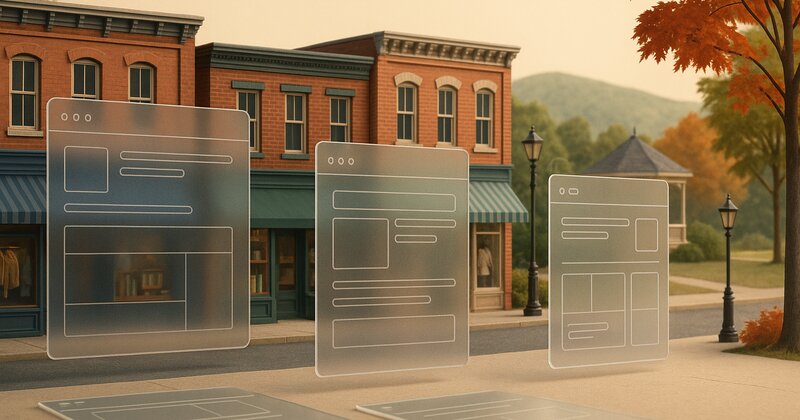
Five Bellows Falls Main Street shops met at the Flat Iron in January 2025 to discuss a shared website. The idea: split the cost of one site (bellowsfallsmainstreet.com or shopbellowsfalls.com) that lists all participating businesses, their hours, their offerings, and contact info. Each shop would pay $40 to $60 per month instead of $200 to $300 for an individual site. The collective site would promote the whole downtown, encourage people to visit multiple shops, and build a sense of community. It sounded smart, collaborative, and cost-effective.
Two months later, one of the five shops (a vintage clothing boutique) built her own site anyway. She explained why: "I Googled 'vintage clothing Bellows Falls VT' and our collective site didn't show up. I Googled my shop name and got a directory page with five other businesses listed above and below mine. A customer visiting from New Hampshire asked ChatGPT where to find vintage clothing in Bellows Falls and ChatGPT didn't mention us because the collective site had no dedicated page about my shop with real information about inventory, pricing, or style. I realized the collective site made me invisible. I needed my own site so I could be found."
She was right. Collective websites (also called downtown directories, merchant association sites, or business district portals) sound like a good idea in theory. In practice, they hurt every participating business's discoverability because search engines and AI tools rank individual businesses, not directories. A collective site makes you one of many listings on a page that ranks for generic queries like "Bellows Falls shopping" but not for specific queries like "vintage clothing Bellows Falls VT" or "bookstore Bellows Falls VT" or "jewelry Bellows Falls VT." Your individual shop becomes invisible to Google, invisible to AI, and invisible to the customers actively searching for what you sell.
This post explains why collective websites fail for retail and Main Street businesses, why individual websites win (even tiny one-page sites), what downtown Bellows Falls businesses actually need to be discoverable, and how to structure a web presence that supports both your individual shop and the collective district without sacrificing your visibility.
Why collective websites sound smart but fail in practice
The pitch for a collective downtown website is compelling: pool resources, share costs, promote the whole district, make it easy for visitors to discover all the shops in one place, and build community. Conceptually, it makes sense. Main Street retail thrives when multiple shops draw foot traffic, when visitors browse several stores in one trip, and when the district feels vibrant and alive. A collective website seems like the digital version of that.
Here is why it fails:
Google ranks businesses, not directories
When someone searches "bookstore Bellows Falls VT" or "vintage clothing Bellows Falls VT," Google looks for websites about that specific business or product category. An individual bookstore website (thebookgarden.com with pages about the store's inventory, events, hours, location) ranks because Google understands the site is about that bookstore. A collective site (shopbellowsfalls.com with a directory page listing 12 businesses including one bookstore) does not rank for "bookstore Bellows Falls VT" because the page is not about the bookstore. It is about the directory. Google sees it as low-relevance for a specific business query.
The collective site might rank for "shopping Bellows Falls VT" or "Main Street Bellows Falls stores," but those are low-intent queries (someone browsing, not someone looking for a specific product or store type). The high-intent queries (people searching for what you specifically sell) go to competitors with individual websites, not to your listing buried on a directory page.
AI tools cannot extract business-specific information from directory listings
When someone asks ChatGPT "Where can I buy handmade jewelry in Bellows Falls Vermont?" ChatGPT looks for websites with detailed information about jewelry shops (inventory descriptions, price ranges, style, whether custom work is available, hours, contact info). An individual jewelry shop website has all of that information on dedicated pages. A collective site has a one-paragraph listing for the jewelry shop with basic info (name, address, hours, "handmade jewelry and gifts"). ChatGPT cannot extract enough detail to confidently cite the shop. It cites competitors with individual websites where the information is rich and extractable.
AI search rewards depth and specificity. A directory listing is shallow by design (short descriptions, limited detail, optimized for browsing not for search). An individual site can go deep (detailed product or service descriptions, pricing, photos, stories, FAQs). AI extracts from the deep content and ignores the shallow listings.
Directory pages dilute relevance and authority
A collective website homepage lists 10 to 20 businesses. A visitor lands on the homepage and has to scroll or search to find the one business they care about. From a search engine perspective, this dilution is a problem. Google and AI try to match a query (specific business or product) to a page (specific content). A directory page with 15 businesses matches no specific query well. It is too broad, too generic, too diffuse.
An individual website matches specific queries perfectly. Someone searches "used books Bellows Falls VT" and lands on a page entirely about used books (inventory, genres, pricing, hours, location). The match is exact. Relevance is high. Google ranks it. A directory page listing a used bookstore alongside a jewelry shop, a cafe, and a vintage clothing store does not match the query cleanly. Google ranks it lower or not at all.
You cannot control or update your own content
On a collective site, you do not control your listing. Someone else (the site admin, the downtown association, a volunteer) controls the content, the layout, the update schedule. If you want to change your hours, add a new product line, post a seasonal promotion, or update your bio, you have to email the admin and wait for them to make the change. This creates friction and delay. Most businesses give up and accept that their listing is stale.
On your own site, you control everything. You can update hours instantly, add new photos today, post a sale tomorrow. You own the content and the timeline. The site reflects your current reality, not a months-old snapshot.
You compete for attention with other businesses on the same page
A collective site lists your shop alongside competitors (or at least other businesses vying for the visitor's attention). A visitor arrives at shopbellowsfalls.com looking for a gift shop. They see five shops listed (a vintage store, a bookstore, a jewelry shop, a gift shop, a cafe). They browse all five, get distracted, and leave without contacting anyone. Or they visit the vintage store instead of the gift shop because the vintage store's photo caught their eye.
On your own site, there is no competition for attention. Every visitor who lands on your site is there to learn about you. They are not browsing a directory. They are evaluating whether to visit your shop. The entire site is optimized to convince them to visit or call. No distractions, no competitors, no split attention.
The cost savings are small and the opportunity cost is huge
A collective site costs $40 to $60 per month per business. An individual site costs $150 to $300 per month (subscription model) or $200 to $500 per year (DIY). The savings are $100 to $250 per month. For a retail shop, that is 5 to 12 sales per month (depending on average transaction size). If your individual website generates even one additional customer per month who would not have found you via the collective site, the individual site pays for itself. The opportunity cost of being invisible in Google and AI search is far higher than the cost savings of sharing a directory.
A Bellows Falls antique shop participated in a collective Main Street site for two years. The shop paid $50/month. The collective site listed 14 businesses. The shop's listing included name, address, hours, phone, and one sentence ("Antiques, vintage furniture, and collectibles"). The shop owner Googled "antique shop Bellows Falls VT" and found competitors from Brattleboro and Chester ranking in the top results. The collective site did not appear. She Googled her shop name and found the collective site (fourth result, below her Google Business Profile, Yelp, and a blog mention). She clicked through and had to scroll past six other businesses to find her listing. She asked ChatGPT "Where can I buy antique furniture in Bellows Falls Vermont?" ChatGPT cited two competitors (one in Brattleboro with an individual website, one in Chester with an individual website). The collective site was not mentioned. She built her own one-page site (antique shop name, description of inventory by era and style, pricing ranges, photos of 12 pieces, hours, location, contact form, link to Google Business Profile). She kept paying for the collective site listing but started directing people to her individual site. Three months later, 60% of her web leads were coming from her individual site (Google search and ChatGPT citations). The collective site generated zero trackable leads. She canceled the collective listing and put the $50/month toward her individual site subscription. Six months later, her web-driven foot traffic had doubled. The individual site worked. The collective site did not.
Why "promoting the whole district" does not require a collective website
The strongest argument for a collective website is that it promotes the whole downtown, encourages visitors to explore multiple shops, and builds a sense of community and collaboration. This is a worthy goal. But you do not need a collective website to achieve it. Individual websites can promote the district just as effectively, without sacrificing each business's discoverability.
Here is how individual sites support the collective district:
Cross-link to neighboring businesses
On your individual site, add a section titled "While you're in Bellows Falls" or "Explore Main Street" and list 3 to 5 other shops you recommend (with links to their websites or Google Business Profiles). Example: "After you visit us, check out [bookstore name] two doors down for great local authors, or grab lunch at [cafe name] across the street." These cross-links help visitors discover other shops, support your neighbors, and signal to Google that Bellows Falls Main Street is a connected ecosystem (which helps all of you rank better for "Bellows Falls shopping" queries).
Mention the downtown experience in your content
On your homepage or About page, describe the Bellows Falls Main Street experience. Example: "We're located on historic Main Street in Bellows Falls, a walkable downtown with antique shops, bookstores, cafes, and galleries. Plan to spend an afternoon exploring." This context helps visitors understand that Bellows Falls is a destination (not just your one shop) and it helps Google and AI associate your business with the broader district.
Collaborate on events and promote them on your individual sites
If Main Street hosts a monthly First Friday event, a holiday open house, or a summer sidewalk sale, promote it on your individual site (homepage banner, event page, blog post if you have one). Link to the event organizer's site or Facebook page. Individual promotion is more effective than collective promotion because each business reaches their own audience and drives traffic to the event.
Support a simple collective directory page (but do not rely on it as your primary web presence)
A collective directory is fine as a supplement. A single-page site (bellowsfallsmainstreet.com) listing all participating businesses with names, addresses, hours, and links to individual websites is useful for visitors who want an overview. But each business still needs its own individual site. The directory is a map, not a destination. It points visitors to individual sites, it does not replace them.
Get listed on local tourism and chamber sites
Most Vermont towns have a chamber of commerce site, a tourism site, or a regional directory (like the Brattleboro Area Chamber of Commerce or a Windham County tourism guide). Get your business listed on these sites (usually free or low-cost). These listings support collective promotion without replacing your individual site. Tourists researching Bellows Falls browse these directories, find your listing, click through to your individual site, and decide to visit.
The goal (promoting the district and driving foot traffic to multiple shops) is achieved through collaboration, cross-promotion, and event coordination, not through a collective website that makes every participant invisible to search engines. Individual sites with cross-links and district context work better than one directory site with 15 shallow listings.
A Bellows Falls gift shop owner wanted to support Main Street collaboration but also wanted her own site. She built an individual site and added a "Explore Bellows Falls" section to her homepage. The section listed five neighboring businesses (a bookstore, a cafe, a vintage shop, an art gallery, and an antique shop) with one-sentence descriptions and links to their sites or Google Business Profiles. She also mentioned the monthly First Friday art walk and linked to the event organizer's Facebook page. Three months later, two of the businesses she linked to reached out to thank her (they had seen referral traffic from her site in their analytics). One of them added a reciprocal link to her shop on their site. A visitor from New Hampshire who found the gift shop via Google search spent three hours in downtown Bellows Falls visiting four of the five shops the gift shop recommended. The cross-links promoted the district without requiring a collective website. The gift shop stayed visible in Google search, the visitor discovered multiple shops, and the district benefited.
What a Bellows Falls Main Street shop actually needs on its individual website
A retail shop on Bellows Falls Main Street does not need an elaborate multi-page website. You need a simple, clear, fast-loading site that proves you exist, explains what you sell, shows your location and hours, and makes it easy for visitors to contact you or find you. Here is the essential structure:
Homepage with clear headline and description
Your headline should say what you sell and where you are. Example: "Vintage clothing and accessories in downtown Bellows Falls, Vermont." Or "Used and rare books on Main Street in Bellows Falls." Or "Handmade jewelry and Vermont gifts in the heart of Bellows Falls." Clear, factual, location-specific. No vague marketing language ("unique treasures" or "one-of-a-kind finds"). Just say what you sell.
Below the headline, add 1 to 2 paragraphs describing your shop. What do you specialize in? What makes you different? What can a visitor expect when they walk in? Example: "We specialize in 1960s through 1990s vintage clothing, with a focus on denim, band t-shirts, and retro jackets. Our inventory changes weekly. We also carry vintage accessories, vinyl records, and locally made jewelry. Open Thursday through Sunday, 11 AM to 5 PM. Located at 123 Main Street, Bellows Falls, Vermont (across from the Flat Iron)."
Product or inventory overview
You do not need to list every item in stock, but give visitors a sense of what you carry. Examples:
For a bookstore: "We carry new and used books in fiction, mystery, history, Vermont authors, children's books, and poetry. We also stock literary journals, greeting cards, and book-related gifts. Special orders are always welcome."
For a gift shop: "Our shop features handmade pottery, Vermont-made candles and soaps, locally roasted coffee, artisan chocolates, greeting cards, and seasonal home decor. Most of our products are made by Vermont and New England artisans."
For an antique shop: "Our inventory includes antique furniture (Victorian through mid-century modern), vintage lighting, collectibles, glassware, estate jewelry, and ephemera. New arrivals every week."
This overview helps Google understand what you sell (so you rank for relevant searches) and helps visitors decide whether to visit (so they know what to expect).
Pricing context (even if you cannot list exact prices)
Give visitors a sense of what things cost. You do not need exact prices for every item (inventory changes, prices vary). But give ranges or starting prices. Examples:
For a vintage clothing shop: "Most items are $15 to $85. Denim jackets start at $40. Band t-shirts are $20 to $50. We always have a clearance rack with items under $10."
For a bookstore: "Used paperbacks start at $3. Hardcovers are $6 to $20. New releases are cover price. Special orders ship free with in-store pickup."
For a jewelry shop: "Handmade earrings start at $28. Necklaces range from $45 to $180. Custom commissions are available (email or call for a quote)."
Pricing context reduces friction. Visitors know whether your shop fits their budget before they drive 30 minutes to visit. Hidden pricing raises red flags and costs you visitors.
Hours, location, and directions
List your hours clearly (days and times). Example: "Open Thursday through Sunday, 11 AM to 5 PM. Closed Monday through Wednesday." If your hours change seasonally, note that ("Open year-round except January and February").
List your address and include context for visitors unfamiliar with Bellows Falls. Example: "123 Main Street, Bellows Falls, VT 05101. We're on the east side of Main Street, between the Flat Iron and the old train station. Free street parking available."
Include a Google Maps embed or a link to your location in Google Maps. Make it easy for visitors to navigate to you.
Contact information and how to reach you
List your phone number, email, and (if you have one) a simple contact form. Make it clear whether visitors can call ahead to check inventory or ask questions. Example: "Questions? Call us at (802) 555-1234, email shop@example.com, or stop by during open hours. We're happy to check inventory for specific items if you call ahead."
Real photos of your shop, inventory, and location
Post at least 8 to 12 photos. Include:
- Exterior of your shop (storefront, signage, building)
- Interior shots (layout, displays, ambiance)
- Close-up shots of products (books, clothing, jewelry, pottery, whatever you sell)
- Photos of you or your team (if you're comfortable)
- Seasonal or event photos (holiday displays, First Friday setups, new arrivals)
Real photos build trust, help visitors visualize the experience, and make your site more engaging. Stock photos of generic shops do not help. Use your phone, take real photos, and update them seasonally.
Link to your Google Business Profile
Add a line that says "Read our Google reviews" or "See what customers are saying" and link to your Google Business Profile. If you have 10+ reviews with a 4.5+ star average, this is social proof. If you have fewer than 10 reviews, work on collecting more before you link prominently.
Optional: events, blog, or news section
If you host events (author signings, trunk shows, First Friday specials, seasonal sales), add an Events section or a simple blog where you post updates. Example: "Join us Friday, March 7 for our spring jewelry trunk show, 5 to 8 PM. Meet three local artisans and see new collections." Events give visitors reasons to come back and they give you fresh content that signals to Google your site is active.
If you do not have time to maintain an events section or blog, skip it. A simple static site with the essentials (description, inventory, pricing, hours, location, contact, photos) works for years without updates.
A Bellows Falls vintage shop built a simple one-page site following this structure. Headline: "Vintage clothing, vinyl, and retro finds in Bellows Falls, Vermont." Description: "We specialize in 1970s through 1990s vintage clothing (denim, band tees, retro jackets, vintage dresses) and vinyl records (rock, punk, jazz, soul). New arrivals every Thursday. Located on Main Street in historic downtown Bellows Falls." Inventory overview: "Our racks include Levi's denim jackets ($45 to $95), vintage band t-shirts ($25 to $60), retro windbreakers and track jackets ($30 to $70), vintage dresses and skirts ($20 to $80), and over 500 vinyl records ($5 to $40)." Hours: "Open Thursday through Sunday, 11 AM to 6 PM." Location: "123 Main Street, Bellows Falls, VT, next to the co-op. Free parking on the street." Contact: phone, email, contact form. Photos: 10 photos (storefront, interior racks, close-ups of jackets and records, photo of the owner). The site launched in three weeks. Within two months, the shop was ranking in the top three Google results for "vintage clothing Bellows Falls VT" and "vinyl records Bellows Falls VT." ChatGPT cited the shop when tourists asked "Where can I find vintage clothing near Brattleboro?" The site cost $250/month (subscription, includes hosting and updates). The shop calculated that the site generated 8 to 12 new visitors per month (people who found the shop via Google or AI search and then visited in person). Average transaction: $65. The site paid for itself with 4 sales per month and generated far more than that.
Why your Google Business Profile is just as important as your website (and how they work together)
An individual website and a complete Google Business Profile work together to make you discoverable. The website provides depth and credibility. The Google Business Profile makes you visible in local search and on Google Maps. You need both.
Here is what your Google Business Profile must include for a Bellows Falls Main Street retail shop:
Complete and accurate address. Make sure your street address is correct and the map pin is accurate. Visitors navigate to you via Google Maps. If the pin is wrong, they get lost.
Business category. Choose the most specific category. "Clothing Store," "Vintage Clothing Store," "Book Store," "Antique Store," "Gift Shop," "Jewelry Store." The category determines what queries you show up for. Do not choose a generic category like "Retail" or "Shopping."
Hours. Keep your hours updated. If you change hours seasonally or close for vacation, update your GBP immediately. Visitors check hours before they drive to you. If your GBP says "open" and you are closed, you lose trust and you lose the sale.
Attributes. Use every relevant attribute. "Women-owned," "LGBTQ+ friendly," "Wheelchair accessible," "Free Wi-Fi," "In-store shopping," "Curbside pickup." Attributes help Google and visitors understand what you offer and what your shop is like.
Description. Write a 150 to 200-word description that includes what you sell, what makes you different, your hours, and your location context. Example: "We're a vintage clothing shop in downtown Bellows Falls, Vermont, specializing in 1970s to 1990s clothing, vinyl records, and retro accessories. Our inventory changes weekly with new arrivals every Thursday. We carry Levi's denim jackets, vintage band t-shirts, retro windbreakers, vintage dresses, and over 500 vinyl records spanning rock, punk, jazz, and soul. Open Thursday through Sunday, 11 AM to 6 PM. Located on Main Street next to the co-op, with free street parking available. Visit us in person or call ahead to check inventory on specific items."
Photos. Upload at least 20 to 30 photos. Include exterior, interior, products, team, events, and seasonal updates. Fresh photos signal to Google (and to visitors) that you are active and current. Update photos every season.
Posts. Post to your GBP at least once or twice a month. Examples: "New arrivals this week: vintage Levi's trucker jackets and 1980s band tees. Come see them before they're gone." Or "Join us this Friday for First Friday on Main Street, 5 to 8 PM. 10% off all vinyl records." Posts keep your GBP active and give visitors timely information.
Reviews. Collect as many detailed Google reviews as possible. Ask every customer to leave a review (especially customers who drove from out of town or who found you via search). Prompt them to mention specifics (what they bought, what they liked, why they recommend you). Detailed reviews help Google understand what you sell and they give AI extractable facts. (See the Google reviews post for how to ask effectively.)
Your website and your GBP reinforce each other. When someone Googles "bookstore Bellows Falls VT," your GBP appears in the map pack and your website appears in the organic results. The visitor sees both, clicks on your GBP to check hours and reviews, clicks on your website to see inventory and photos, and decides to visit. One without the other is incomplete.
A Bellows Falls bookstore had a complete website but a sparse Google Business Profile (address, phone, 6 reviews, no description, no attributes, 3 photos). The website ranked well ("bookstore Bellows Falls VT" top three results), but the GBP listing looked thin compared to competitors with 40+ photos and detailed descriptions. The bookstore updated their GBP (added description with inventory details and hours, added attributes for wheelchair accessible and in-store shopping, uploaded 25 new photos, posted weekly updates about new arrivals and events). Within three weeks, the GBP started appearing more prominently in "near me" searches and Google Maps. ChatGPT started citing the bookstore more often (ChatGPT pulls from GBP data). The complete GBP and the complete website worked together to maximize visibility. Before the update, 60% of web leads came from the website and 40% from walk-ins or referrals. After, 50% came from the website, 30% from the GBP (people who found the shop via Maps or local search), and 20% from walk-ins or referrals. The GBP captured a new lead source the website alone could not.
Why "I don't have time to manage a website" is a solvable problem for retail shops
Many Bellows Falls Main Street shop owners resist building an individual website because they assume it requires constant updating, posting, and content management. Good news: a retail shop website does not need constant attention. It is a static reference, not a blog or a social media feed.
Here is the realistic time commitment:
Initial build: If you hire a developer, the time commitment is 2 to 4 hours (one kickoff meeting to discuss what you want, one meeting to review content and photos, one final review before launch). If you build it yourself using a platform, the time commitment is 8 to 12 hours over a weekend or two.
Ongoing updates: Once or twice per season (every 3 to 4 months), spend 30 to 60 minutes updating photos (new inventory, seasonal displays), updating hours (if they change), and updating any pricing or product descriptions. That is it. You do not need to post weekly. You do not need to write blogs. A static site with accurate information is enough.
Optional fresh content: If you want to post updates about new arrivals, events, or sales, you can add a simple News or Events section. Post once or twice a month (takes 10 to 15 minutes per post). This is optional. Many successful retail sites never post updates and work perfectly well as static references.
The myth that a website requires constant work is left over from the blogging era (2000s and early 2010s). Modern small-business websites (especially custom-coded, fast-loading sites) require minimal ongoing effort. You build it, you launch it, you update it a few times a year. It works 24/7 without requiring daily or weekly management.
A Bellows Falls jewelry shop owner worried she did not have time to "maintain a website." She built a simple one-page site in March 2024. One year later, she had updated the site exactly three times: once to add new product photos (May, took 45 minutes), once to update her summer hours (June, took 5 minutes), and once to add a holiday event announcement (November, took 10 minutes). Total time: 60 minutes over 12 months. The site had been live for a year, had generated 25+ leads (people who found her via Google search or AI), and required one hour of her time total. The site worked while she worked. She did not have to manage it, post to it, or think about it. It was a tool, not a burden.
How collective promotion can still work (without sacrificing individual visibility)
Bellows Falls Main Street businesses can still collaborate and promote the district collectively without building a collective website. Here are strategies that support both individual discoverability and collective promotion:
Build a simple single-page directory as a supplement (not a replacement)
Create a single-page site (bellowsfallsmainstreet.com or shopbellowsfalls.com) that lists all participating businesses with name, category, address, hours, and a link to each business's individual website or Google Business Profile. This directory is useful for visitors who want an overview of what is on Main Street, but it is not a replacement for individual sites. Each business still needs its own site for depth and discoverability. The directory is a map, not a destination.
Cost: $50 to $100/year (domain and hosting). Maintenance: one person updates the directory once per quarter (adding new businesses, removing closed businesses, updating links). Each business pays $0 to $10/year to be listed. The directory supplements individual sites without replacing them.
Collaborate on First Friday, seasonal events, and downtown-wide promotions
Plan and promote events together (First Friday art walks, holiday open houses, summer sidewalk sales). Each business promotes the event on their individual website, social media, and Google Business Profile. Visitors see the event promoted by multiple businesses, which builds momentum and drives turnout. Individual promotion is more effective than collective promotion because each business reaches their own audience.
Cross-link to each other's websites
Add a "While you're in Bellows Falls" or "Explore Main Street" section to your individual site and link to 3 to 5 neighboring businesses. Reciprocal cross-links help all of you rank better in Google (Google values links from relevant local sites) and they help visitors discover multiple shops. Cross-linking is collective promotion without the drawbacks of a collective website.
Get listed on regional tourism and chamber directories
Make sure your business is listed on the Brattleboro Area Chamber of Commerce site, any Windham County tourism guides, and Vermont-wide directories (like VisitVT.com). These third-party directories provide collective promotion without replacing your individual site. Tourists research the area, browse these directories, find your listing, click through to your individual site, and decide to visit.
Collaborate on content (blog posts, visitor guides, regional features)
If a local blogger, a regional magazine, or a Vermont tourism site is writing a "Guide to Bellows Falls" or "Best Shops in Windham County" article, participate. Get quoted, get featured, get linked. These third-party mentions benefit all participating businesses (collective promotion) while driving traffic to individual websites (individual visibility).
Collective promotion and individual websites are not mutually exclusive. You can collaborate on events, cross-link, support a simple directory, and get listed on third-party sites while maintaining your own individual web presence. The two strategies reinforce each other.
A group of eight Bellows Falls Main Street shops tried this hybrid approach in 2024. Each shop built (or already had) an individual website. They also created a simple single-page directory site (shopbellowsfalls.com) listing all eight businesses with names, categories, addresses, hours, and links to individual sites. Each shop paid $8/year to cover the domain and hosting. The directory was hosted on a cheap shared plan and updated quarterly by one volunteer. Each shop added a "Explore Main Street" section to their individual site linking to the other seven shops. They collaborated on monthly First Friday events and each shop promoted the event on their own site and GBP. One year later, the results: the directory site ranked for "Bellows Falls shopping" and "Main Street Bellows Falls stores" (low-intent browsing queries). Individual shop sites ranked for specific queries ("bookstore Bellows Falls VT," "vintage clothing Bellows Falls VT," "jewelry Bellows Falls VT"). Visitors found shops via both paths (browsing the directory, or searching for specific products and landing on individual sites). The eight shops calculated that 70% of web-driven traffic came from individual sites (high-intent, product-specific searches) and 30% came from the directory (browsing, tourists planning a trip). The hybrid approach worked. Individual sites captured high-intent leads. The directory supported collective promotion and browsing discovery. Neither replaced the other. They complemented each other.
What to do if you are already listed on a collective site and you want your own site
If your Bellows Falls shop is already listed on a collective Main Street site and you are realizing it is hurting your discoverability, here is what to do:
Step one: Build your individual site (or hire someone to build it)
Do not wait for the collective site to improve or for permission from the organizer. Build your own site now. Use the structure outlined earlier (headline, description, inventory, pricing, hours, location, contact, photos). Launch it as quickly as possible (2 to 4 weeks if you hire a developer, 1 to 2 weekends if you DIY).
Step two: Claim (or update) your Google Business Profile
Make sure your GBP is complete and link to your new individual website (not the collective site). Update your description, hours, photos, and attributes. Collect reviews.
Step three: Decide whether to stay listed on the collective site
If the collective site is free or very low cost ($10 to $20/year), you can stay listed as a supplemental directory presence. Update your listing to link to your individual site. If the collective site costs $40 to $60/month and is not generating leads, cancel your listing and redirect that budget to your individual site.
Step four: Test your visibility
Google your business name and your core product/service queries ("bookstore Bellows Falls VT," "vintage clothing Bellows Falls VT"). See whether your individual site shows up in the top results. Ask ChatGPT and Perplexity the questions tourists or locals would ask ("Where can I buy handmade jewelry in Bellows Falls?" "What are the best shops in Bellows Falls Vermont?"). See whether your business is cited. If yes, your individual site is working. If no, identify gaps (missing content, missing reviews, missing citations) and fix them.
Step five: Promote your individual site
Add your website URL to your business cards, receipts, signage, social media profiles, email signature, and Google Business Profile. When someone asks for your website, give them your individual URL (not the collective site). Drive traffic to the site you control.
You do not need permission to build your own site. You do not need to abandon the collective effort (you can still participate in events, cross-link, and support a simple directory). But you need your own site to be discoverable in Google and AI search. The collective site is a supplement, not a substitute.
A Bellows Falls gift shop was listed on a collective site for 18 months. The shop paid $50/month. The collective site generated zero trackable leads. The shop owner Googled "gift shop Bellows Falls VT" and her shop did not appear in the top results (the collective site appeared on page two). She built her own one-page site in four weeks. She updated her Google Business Profile to link to her new individual site. She kept her listing on the collective site (it was a sunk cost for the remaining six months of her annual contract), but she stopped promoting the collective URL. She promoted her individual site instead. Three months later, her individual site was ranking in the top three Google results for "gift shop Bellows Falls VT" and "Vermont gifts Bellows Falls." ChatGPT cited her when tourists asked "Where can I buy Vermont-made gifts near Brattleboro?" The individual site generated 12 to 15 leads per month. The collective site still generated zero. When her collective site contract expired, she canceled it and redirected the $50/month to her individual site subscription. Six months later, her web-driven revenue had tripled. The individual site worked. The collective site never did.
The bottom line: individual websites win because search engines rank businesses, not directories
Collective websites sound collaborative and cost-effective, but they fail because Google and AI rank businesses, not directories. When someone searches for what you sell ("vintage clothing Bellows Falls VT," "bookstore Bellows Falls VT," "handmade jewelry Bellows Falls VT"), Google looks for websites about that specific business or product. An individual site matches the query perfectly. A directory page listing 15 businesses is too broad, too generic, and too diffuse. Google ranks the individual site. AI cites the individual site. The directory is invisible.
Every Bellows Falls Main Street shop needs an individual website. Not a fancy one. Not a multi-page content marketing machine. Just a simple, clear, fast-loading site that says what you sell, shows your inventory, lists your hours and location, displays real photos, and makes it easy to contact you or visit. One page is enough. It takes 2 to 4 weeks to build (if you hire a developer) or 1 to 2 weekends (if you DIY). It costs $150 to $300/month (subscription model) or $200 to $500/year (DIY with a site builder). It pays for itself the first month it generates even one customer who found you via Google or AI search.
You can still collaborate with other Main Street businesses. You can cross-link, promote events together, support a simple directory as a supplement, and build a collective sense of place. But do not sacrifice your individual discoverability for the sake of collective cost savings. The opportunity cost (invisible in Google, invisible in AI, losing high-intent customers to competitors with individual sites) is far higher than the cost of an individual site. Build your own site. Control your own content. Rank for your own queries. Capture your own leads. Support the collective downtown through collaboration, not through a collective website that makes everyone invisible.
The businesses that thrive on Bellows Falls Main Street in 2025 and beyond will be the ones with individual websites that rank in Google, get cited by AI, and provide the depth and proof that turn searchers into visitors. The businesses that rely on collective directories will wonder why foot traffic is down, why younger customers are not finding them, and why competitors from other towns are capturing their market. Build your own site. Be discoverable. Win the search.
Want to see exactly how discoverable your Bellows Falls shop is in Google search, Google Maps, and AI tools (ChatGPT, Perplexity), get a side-by-side comparison of your visibility vs. Main Street competitors, and get a clear roadmap for building (or improving) the individual website that captures high-intent customers searching for what you sell? The free 27-point local SEO audit checks your current web presence (website, Google Business Profile, reviews, citations), runs your core queries in Google and AI, records what shows up (and what does not), and gives you a prioritized action plan. If you do not have an individual site yet, the audit shows you exactly what you are losing and what you need to build. If you are listed on a collective site, the audit shows you why it is not working and how an individual site would perform. No pitch, just the diagnostic and the roadmap. See the portfolio of sites we have built for southern Vermont retail and service businesses, or check out the pricing for a custom subscription site (fast-loading, mobile-optimized, includes hosting and updates, no ongoing maintenance burden on your end).
Keep reading
How much does a website cost in West Dover, Vermont? (2026 honest breakdown)
DIY vs freelancer vs agency vs custom-coded: what drives the number in 2026, from $0 Wix sites to $15K agency builds, with no fluff and real tradeoffs for West Dover lodging, dining, and ski-season businesses.

How much does a website cost in Putney, Vermont? (2026 honest breakdown)
A Putney farm store owner got quotes from $800 to $9,000 for a website and had no idea which was fair. Here's what drives the number, what you get at each price tier, and what actually matters for a small business in 2026.

How much does a website cost in Wilmington, Vermont? (2026 honest breakdown)
A Wilmington restaurant paid $4,800 for a WordPress site that loaded in 7 seconds. A competitor paid $3,000 for a custom site that loaded in 1.8 seconds and ranked higher. Here's what actually drives website costs in 2026.