
Web Design · August 28, 2026 · 33 min read
Why Putney businesses need a website even when most customers already know them
In a town where everyone knows everyone, a website feels redundant. Until someone Googles you at 9 PM, asks ChatGPT for a recommendation, or tries to find your hours on Sunday. Trust and credibility require proof, not just familiarity.
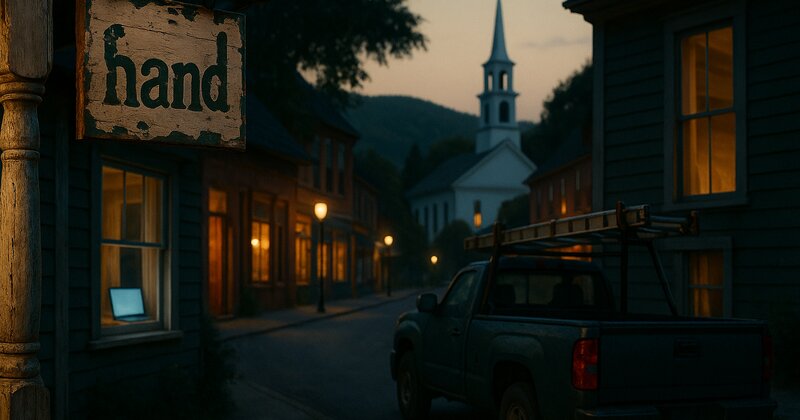
A Putney electrician has lived in town for 38 years. He went to high school here, his kids went to elementary school here, he coaches Little League, he serves on the fire department. When his truck drives down the main road, half the people he passes know him by name. He gets most of his work through word-of-mouth and referrals. He has never needed to advertise. In 2024, he decided he did not need a website either. Why pay for something when everyone already knows who he is?
In November 2024, a family moved to Putney from Massachusetts. Their panel needed an upgrade to support a Level 2 EV charger. They did not know anyone in town yet, so they asked a neighbor for an electrician recommendation. The neighbor said "Oh, call [electrician's name], he's great, been here forever." The new family Googled the name. No website. They found an old Angie's List profile with no reviews and no contact information. They Googled "electrician Putney VT" and found two other electricians with websites, phone numbers, service descriptions, and Google reviews. They called one of those electricians. The Putney electrician lost the job, not because the neighbor did not recommend him, not because he was not qualified, but because the new family could not verify him online. No website meant no trust. Familiarity in town did not transfer to a stranger searching Google at 9 PM on a Tuesday.
This is the trap Putney businesses fall into. In a small town where relationships and reputation matter, a website feels redundant. Everyone knows you. Everyone knows your work. You do not need to prove yourself to the community. But your future customers are not all locals who grew up here. They are new residents, second-home owners, tourists, remote workers who just moved to Vermont, people passing through, or people who live two towns over and do not know your reputation. They search Google, they ask ChatGPT, they check Yelp. If you are not there with verifiable information (a website, reviews, contact info, credentials), you do not exist to them. Word-of-mouth gets you the referral, but the website closes the deal.
This post explains why even the most well-known Putney businesses need a website, what happens when you rely on familiarity without proof, and what a credible web presence looks like for a small Vermont service business where trust and relationships are everything.
Why "everyone knows me" is not enough anymore (even in Putney)
Putney is a town of about 2,600 people. It is the kind of place where you run into someone you know at the co-op, where the same families have lived for generations, where your reputation is built on decades of work and relationships. In this environment, a website can feel like overkill. If everyone knows you, why do you need to introduce yourself online?
The problem: not everyone in your service area knows you, and the percentage of people who do know you is shrinking every year.
New residents do not know your reputation. Putney and the surrounding towns (Dummerston, Brookline, Westminster, Grafton, Newfane) have seen an influx of new residents over the past five years (remote workers, retirees, people leaving cities for Vermont). These new residents do not know who the trusted plumber is, who the reliable contractor is, who the best accountant is. They ask neighbors for recommendations, but then they Google the name to verify. If you have no website and no reviews, they cannot verify you. They move on to someone they can verify.
Tourists and second-home owners are not locals. Putney has a mix of year-round residents and seasonal visitors (second-home owners, people renting vacation properties, tourists staying in the area). When a second-home owner's furnace breaks in January or a vacation rental needs an emergency plumber, they do not know the local experts. They search Google or ask ChatGPT. If you are not online, you do not get the call.
People two towns over do not know you. Your service area probably includes Brattleboro, Westminster, Grafton, Townshend, or Bellows Falls. A homeowner in Bellows Falls does not know the Putney contractor's reputation the way a Putney resident does. They search "contractor near me" or "contractor Bellows Falls VT." If you have no website and no online presence, Google does not surface you. They hire someone from Bellows Falls who does have a website.
Younger customers expect to verify everything online. Even if a 30-year-old Putney resident grew up hearing about your business, they still Google you before hiring you. They want to see your website, read your reviews, check your credentials, see photos of your work. Familiarity is not enough. They need proof. If you have no online presence, they question whether you are still in business, whether you are legitimate, whether you are keeping up with the times.
AI search does not know your local reputation. When someone asks ChatGPT "Who are good electricians in Putney Vermont?" ChatGPT does not know that you have lived here for 38 years or that you coach Little League. It only knows what it can find online (your website, your reviews, your mentions in news articles or directories). If you have no online presence, ChatGPT does not cite you. It cites competitors with websites and reviews, even if those competitors are newer or less experienced than you.
A Putney HVAC contractor assumed everyone in town knew him (he had been in business for 24 years, his father ran the business before him for 30 years, the family name was well-known). He had no website. In 2024, a new resident (a remote worker who moved from Boston) needed a heat pump installed. She asked a neighbor. The neighbor said "Call [contractor name], his family has been doing HVAC here forever." The new resident Googled the name. No website, no reviews, just an old Yellow Pages listing with a disconnected phone number. She Googled "heat pump installation Putney VT" and found two other HVAC companies with websites, photos of installations, pricing information, and Google reviews. She called one of them. The Putney contractor lost a $12,000 job because he had no online presence to verify the neighbor's recommendation. The referral got him into the consideration set, but the lack of a website knocked him out.
What happens when someone Googles your business and finds nothing
When a potential customer Googles your business name and finds nothing (no website, no Google Business Profile, no reviews, no directory listings), here is what they think:
"Are they still in business?" No website, no recent activity, no way to verify. The customer assumes you might have closed or retired. Even if a friend just recommended you last week, the lack of online presence raises doubt.
"Are they legitimate?" Every business has a website now, even solo contractors and freelancers. If you do not have one, the customer wonders why. Are you avoiding scrutiny? Are you unlicensed? Are you operating informally? The lack of a website signals unprofessionalism or lack of credibility, even if neither is true.
"Are they any good?" With no reviews, no portfolio, no credentials displayed, the customer has no way to evaluate your quality. Word-of-mouth got them interested, but they need proof. If you have no proof online, they cannot move forward with confidence.
"How do I contact them?" If your phone number is not listed online, if you have no email or contact form, the customer has to work harder to reach you. Many people will not bother. They will call a competitor whose phone number is on their website and Google Business Profile.
"Do they serve my area?" If you have no website, the customer does not know your service area. They assume you only work in Putney. If they live in Westminster or Grafton, they assume you are too far away, even if you regularly work in those towns.
"What do they charge?" With no pricing information online (not even rough ranges), the customer assumes you are expensive or that you hide pricing. They feel anxious about calling and getting a quote. They move on to a competitor who lists pricing or at least says "free estimates."
The lack of a website does not just make you invisible to search engines. It makes you unverifiable to humans. In 2025, "no online presence" is a red flag, not a sign of small-town authenticity.
A Putney bookkeeper had been doing tax prep and bookkeeping for local individuals and small businesses for 19 years. She had no website, no email address (she gave clients her personal Gmail), no Google Business Profile. Her clients were all referrals from existing clients. In early 2024, a Putney resident referred a friend (a new small business owner in Brattleboro) to the bookkeeper. The friend Googled the bookkeeper's name. Nothing. She searched "bookkeeper Brattleboro VT" and found five bookkeepers with websites, credentials, and reviews. She assumed the referred bookkeeper was either not taking new clients or not credible (why else would she have no online presence?). She hired one of the five she found on Google. The Putney bookkeeper lost the client because she was unverifiable. The referral was strong, but the lack of web presence killed trust.
Why a website is proof, not promotion
Many Putney business owners resist building a website because they think of it as advertising or self-promotion, and that feels uncomfortable or unnecessary in a small town where humility and relationships matter more than hype. But a website is not advertising. It is proof. It is verification. It is the modern equivalent of a storefront sign or a business card. It says "I am real, I am professional, I am open for business, here is how to reach me, here is what I do, here is evidence that I do it well."
Here is what a good small-business website proves:
You are still in business. An active website (updated in the last year, with current contact info and a recent copyright year in the footer) signals that you are operational. A missing website signals uncertainty.
You are professional and credible. A clean, simple website with clear information (services, credentials, contact info) signals that you take your business seriously. It does not have to be fancy. It just has to exist and look competent.
You know what you are doing. A website that lists your services clearly, describes your process, shows examples of your work, and displays your credentials proves that you have expertise and experience. Vague word-of-mouth ("he's good") is not enough for a skeptical customer. The website provides the evidence.
You are trustworthy. A website with transparent pricing (or at least "free estimates"), clear contact information, real photos of your work, and a link to your Google reviews signals honesty and transparency. Hidden pricing, no contact info, and no reviews signal the opposite.
You are easy to work with. A website with your hours, your service area, your contact methods (phone, email, contact form), and your typical process (how long projects take, what to expect) makes it easy for a customer to decide whether you are the right fit. No website means the customer has to call and ask basic questions, which feels like friction.
A custom-built website is not a billboard. It is not a sales pitch. It is a reference document. It is what people check after they hear about you, after they get your name from a friend, after they see your truck, after they meet you at the town meeting. The website does not replace relationships. It reinforces them. It turns "I heard about you" into "I checked you out and I trust you."
A Putney general contractor resisted building a website for years. He thought it felt too corporate, too salesy for a small Vermont town where his reputation was built on relationships. Then he lost three jobs in six months (all referrals from happy clients) because the referred customers Googled him, found nothing, and hired competitors with websites. He finally built a simple one-page site. Homepage with his name, photo, services (remodeling, additions, kitchens, decks), credentials (licensed contractor in Vermont, 22 years of experience, member of Vermont Builders Association), service area (Putney, Westminster, Grafton, Townshend, Dummerston), contact info (phone, email, contact form), and a link to his Google Business Profile (18 reviews, 4.9 stars). The site took one weekend to build. Three weeks later, a referred customer called him and said "I Googled you, saw your site and your reviews, and I knew you were the right person." The website did not sell the customer. The referral did. The website just provided the proof the customer needed to move forward with confidence.
What "after-hours discovery" means and why it matters in a small town
Most referrals and word-of-mouth recommendations happen during the day (someone asks a coworker, a friend mentions you at lunch, a neighbor brings you up in conversation). But most online research happens after hours (evenings, weekends, late at night when someone is lying in bed thinking about the project they need done).
A homeowner in Putney decides on a Sunday afternoon that they need to replace their roof before winter. They text a friend: "Do you know a good roofer?" The friend texts back: "Yeah, call [roofer name], he did ours, great work." It is 7 PM on Sunday. The homeowner Googles the roofer's name to get the phone number and see some examples of their work. If the roofer has a website, the homeowner spends five minutes reading about the services, looking at project photos, checking the reviews, and noting the phone number. Monday morning at 9 AM, they call. The roofer gets the lead.
If the roofer has no website, the homeowner finds nothing. They think "I'll ask my friend for the number tomorrow." Monday morning comes, they get busy, they forget. Or they Google "roofer Putney VT" Sunday night, find two other roofers with websites and reviews, and call one of them Monday morning. The referred roofer never gets the call because the homeowner could not verify them when they were motivated to research (Sunday evening). The timing mismatch killed the lead.
After-hours discovery is critical because it is when people have time to research, compare, and make decisions. If you are not discoverable and verifiable after hours (when your phone is off, when your office is closed, when you are not available to answer questions), you lose leads to competitors who are discoverable 24/7 via their website.
A website works for you when you are not working. It answers questions, provides proof, and collects contact form submissions at 10 PM on a Saturday or 6 AM on a Sunday. It captures leads from people who are ready to hire but do not want to call until Monday. It turns "I'll look into this later" into "I just submitted a contact form and I'm ready to talk."
A Putney plumber had no website. He got a referral from a happy customer on a Friday afternoon. The referred customer (a new homeowner in Westminster) planned to call Monday morning. Friday night at 11 PM, the water heater started leaking. The homeowner panicked, Googled "emergency plumber Westminster VT," and found two plumbers with websites that said "24/7 emergency service" and listed phone numbers. The homeowner called one of them. The Putney plumber (who also offers emergency service) never got the call because he was not discoverable online when the emergency happened. The referral was strong, but the lack of after-hours discoverability cost him a $1,200 emergency job plus a $4,500 water heater replacement.
What a credible website looks like for a Putney service business
A credible website for a Putney service business does not need to be elaborate. It does not need animations, videos, or a blog. It needs to be clear, factual, and verifiable. Here are the essentials:
One-page or simple multi-page structure
For most small service businesses (contractors, electricians, plumbers, landscapers, accountants, lawyers), a single-page website is enough. Sections: introduction (who you are, what you do), services (list of what you offer), service area (towns you cover), credentials (license, years in business, certifications), contact (phone, email, form). If you want a multi-page site, add separate pages for services, about, and contact. Keep it simple.
Your name, photo, and story
List your name prominently. Include a real photo of yourself (or your team). Add one or two paragraphs about your background (how long you have been in business, why you do this work, what makes you different). People in Vermont care about who they are hiring. A real face and a real story build trust.
Clear service list
List every service you offer. Be specific. "General contracting: kitchen remodels, bathroom remodels, additions, decks, siding, roofing, flooring, custom carpentry." Not "quality home improvement services." The clearer you are, the easier it is for a customer to know whether you do what they need.
Service area by town name
List the towns you serve by name. "We serve Putney, Westminster, Dummerston, Grafton, Brookline, Townshend, and Newfane." Do not say "serving the area" or "serving southern Vermont." Be specific. This helps with local search (Google and AI index town names) and it helps customers know whether you cover their location.
Credentials and experience
List your license (if applicable), certifications, professional memberships, years in business, and number of projects or clients. "Licensed electrician in Vermont (license #12345), 18 years of experience, member of the Vermont Electrical Contractors Association, completed 800+ service calls and installations since 2007." Credentials prove you are legitimate and qualified.
Transparent pricing (or at least "free estimates")
If you can list pricing (even rough ranges), do it. "Service calls start at $95. Panel upgrades typically cost $1,800 to $3,500 depending on the panel size and complexity." If you cannot list pricing (every job is custom), at least say "We provide free estimates" or "Call for a free quote." Transparent pricing builds trust. Hidden pricing raises red flags.
Real photos of your work
Show before-and-after photos, project photos, or photos of your team at work. Real photos prove you do the work and they help customers visualize the quality. Stock photos of generic contractors or landscapes do not help. (See the stock photos vs. real photos post for more on this.)
Contact information on every page
List your phone number, email, and physical address (or at least service area) in the footer of every page. Add a simple contact form. Make it easy for someone to reach you. If they have to hunt for your contact info, they will leave.
Link to your Google Business Profile and reviews
Add a line that says "Read our Google reviews" and link to your Google Business Profile. If you have 15+ reviews with a 4.5+ star average, this is social proof that reinforces trust. If you have fewer than 10 reviews, work on collecting more before you link to them prominently.
Simple, fast, mobile-friendly design
Your site needs to load fast (under 3 seconds) and look good on mobile (60% to 70% of traffic will be mobile). It does not need to be fancy. Clean, simple, readable text. Clear headings. Easy navigation. No clutter. A custom website built for speed is better than a slow WordPress site with a heavy template.
A Putney landscaper built a simple one-page website following this structure. Headline: "Landscaping, mowing, and property maintenance in Putney and surrounding towns." Photo: him and his truck in front of a completed project. Introduction: "I'm [name], and I've been doing landscaping and property maintenance in Windham County for 16 years. I live in Putney and work in Putney, Westminster, Grafton, Dummerston, and Townshend. I offer mowing, trimming, mulching, spring and fall cleanups, gardens, and snow removal." Services: bullet list (weekly mowing, trimming and edging, mulch delivery and spreading, spring cleanup, fall cleanup, perennial gardens, snow plowing and shoveling). Pricing: "Mowing starts at $40 per visit. Spring or fall cleanup typically costs $300 to $600 depending on property size. Call for a free estimate on larger projects." Credentials: "Certified Vermont arborist, member of the Vermont Nursery and Landscape Association, 16 years in business." Contact: phone, email, simple contact form. Link to Google Business Profile (22 reviews, 4.8 stars). The site took one day to build. Within two months, 40% of his new leads were coming from the website (people who Googled him after a referral, or people who found him via Google search). The site did not replace word-of-mouth. It reinforced it and captured the leads that word-of-mouth started.
Why Google Business Profile is not enough (you still need a website)
Some Putney business owners think "I have a Google Business Profile with my hours, phone number, and reviews. That's enough. I don't need a website." A Google Business Profile is critical (it is the first thing people see when they Google your business name or search for your service + location). But it is not enough on its own.
Here is what a Google Business Profile cannot do:
It cannot show depth. Your GBP lists your services in short bullet points. It does not explain your process, your credentials, your service area in detail, or your pricing. A website gives you space to provide context and detail.
It cannot display a portfolio. You can upload photos to your GBP, but they are small thumbnails in a grid. A website lets you display project photos large, with captions and descriptions, so customers can see the quality and scope of your work.
It cannot tell your story. Your GBP has a short description field (750 characters). A website has an About page where you can tell your story, explain your background, list your credentials, and build a personal connection.
It cannot be customized or controlled. Google controls your GBP layout, design, and what information is displayed. You cannot change the design, add sections, or prioritize certain information. A website is yours. You control the layout, the messaging, and the user experience.
It cannot capture leads when Google is down or your GBP is suspended. If Google suspends your Business Profile (this happens occasionally due to algorithm errors or policy violations), your entire online presence disappears until you fix it. If you have a website, people can still find you via organic search or direct URL.
It does not work well for AI search. ChatGPT, Perplexity, and Claude pull some information from Google Business Profiles, but they pull more detailed information from websites. A website gives AI more content to extract and cite (service descriptions, pricing, process details, credentials, examples). If you only have a GBP, AI has less to work with.
A Google Business Profile and a website work together. The GBP gets you found in local search and shows your reviews. The website provides the depth, the proof, and the credibility that turns a searcher into a customer.
A Putney accountant had a complete Google Business Profile (hours, services, phone, 14 reviews) but no website. She assumed the GBP was enough. In 2024, someone asked ChatGPT "Who are good CPAs in Putney Vermont for small business taxes?" ChatGPT did not mention her. It cited two competitors, both of whom had websites with detailed service pages (tax prep, bookkeeping, business consulting), transparent pricing, credentials (CPA license, professional associations), and process descriptions (how the tax prep process works, timelines, what documents are needed). ChatGPT extracted this information from their websites and cited them. The Putney accountant's GBP had the basics (phone, services, reviews) but no depth. ChatGPT had nothing to extract and cite. She built a simple three-page website (homepage, services, about/contact) with detailed service descriptions, pricing, credentials, and a process overview. She tested ChatGPT two weeks later. Now she was cited. The website gave AI the content it needed.
How to handle "I don't have time to manage a website"
The most common objection from busy Putney business owners: "I don't have time to update a website or write blog posts or manage content." Good news: you do not need to. A small-business website is not a blog or a content marketing platform. It is a static reference document. You build it once, and you update it once or twice a year (when your credentials change, when your pricing changes, when you want to add new project photos).
Here is the time commitment:
Initial build: If you hire someone to build your site, the time commitment is 2 to 4 hours (one meeting to discuss what you want, one meeting to review the draft, one meeting to review the final version before launch). If you build it yourself using a simple platform, the time commitment is 8 to 12 hours over a weekend. Either way, it is a one-time investment.
Ongoing updates: Once or twice a year, spend 30 minutes updating your bio (years in business, project count, new credentials), updating your pricing if it changed, and adding a few new project photos. That is it. You do not need to post weekly. You do not need to write blogs. You do not need to manage social media. A static website with accurate information is enough.
Adding new content (optional): If you want to add a new service page or a portfolio section later, that is a 1-to-2-hour project. But it is optional. A simple one-page site with the essentials works for years without major changes.
The idea that a website requires constant attention is a myth left over from the blogging era. A modern small-business website (especially a custom-built, fast-loading site) requires almost no ongoing work. You build it, you launch it, you update it annually. It works for you 24/7 without requiring daily or weekly effort.
A Putney contractor was hesitant to build a website because he thought he would have to "keep it updated" and "post regularly." He finally built a simple one-page site in early 2024. One year later, he had updated it exactly twice (once to change his phone number when he got a new business line, once to add three new project photos). The site had been live for 12 months, had generated 30+ leads, and required less than one hour of his time total. The website worked while he worked. He did not have to "manage" it.
Why "I get all my work from referrals" is not a strategy anymore
Many Putney business owners say "I get all my work from word-of-mouth and referrals. I don't need a website or marketing." This was a viable strategy 10 or 15 years ago. In 2025, it is risky. Here is why:
Referrals still require verification. As covered earlier, a referral gets you into the consideration set, but the customer still Googles you to verify. If you have no website and no online presence, the referral dies.
Your referral network is aging. The people who refer you today (long-time customers, neighbors, friends) are aging. Younger customers (30s, 40s, 50s) expect to verify everything online. They get a referral, they Google you, they check your reviews. If you are not online, they do not trust the referral enough to act on it.
New residents do not know your referral network. Putney and the surrounding towns have seen an influx of new residents who do not know the long-time locals who refer you. A new resident asks a coworker in Brattleboro (not a Putney local) for a contractor recommendation. The coworker does not know you. The new resident Googles "contractor Putney VT" and finds competitors with websites. You never enter the consideration set.
Referral volume is unpredictable. If you rely 100% on referrals, your lead flow is entirely dependent on whether your past customers happen to talk to someone who needs your service this month. Some months you get five referrals. Some months you get zero. A website gives you a predictable secondary lead source (people who find you via search, people who verify you after a referral and then contact you directly).
You have no control or visibility. If you rely only on referrals, you have no idea how many potential customers heard about you but did not hire you (because they Googled you and found nothing, or because they forgot to follow up). A website with a contact form captures leads you would otherwise lose. You can see how many people visited, how many submitted a form, and you can follow up.
Referrals are valuable. They are often your highest-quality leads (pre-qualified, pre-sold, high trust). But referrals in 2025 require verification. A website is the verification layer that turns referrals into customers.
A Putney mason had relied 100% on referrals for 28 years. No website, no advertising, no Google Business Profile. In 2023 and 2024, he noticed his referral conversion rate dropping. People would say "I'll call you" and then never call. He finally asked a customer why they almost did not hire him. The customer said "I Googled you and found nothing. I wasn't sure you were still in business. I almost hired someone else, but my friend who referred you convinced me to call." The mason realized he was losing referrals because he was unverifiable. He built a simple website (one page, services, credentials, contact info, link to new Google Business Profile). Six months later, his referral conversion rate was back up. The referrals were the same, but now they converted because customers could verify him online before calling.
What happens when you ask ChatGPT or Perplexity for recommendations and you have no website
In 2025, a growing percentage of Putney-area residents and visitors are using AI search (ChatGPT, Perplexity, Google AI Overviews) to find local services. Someone asks ChatGPT "Who are good plumbers in Putney Vermont?" or "Where should I hire a landscaper near Putney?" If you have no website, no reviews, and no online presence, you are invisible to AI.
AI search works by reading websites, reviews, directories, news articles, and Q&A platforms, extracting facts, and synthesizing recommendations. If you are not online, AI has nothing to extract. It cites competitors who are online, even if those competitors are newer, less experienced, or less well-known locally.
Here is what AI needs to cite you:
A website with clear, factual content. Services, service area, credentials, pricing, contact info. AI extracts this information and uses it to decide whether to recommend you.
Reviews on Google, Yelp, or industry platforms. AI reads reviews to verify that you do good work and that customers are satisfied. Detailed reviews (describing specific services and outcomes) are weighted more heavily than generic reviews.
Third-party mentions. News articles, blog posts, directory listings, Q&A answers. AI treats third-party mentions as validation. If you are mentioned in a local blog or a Vermont news site, AI is more likely to cite you.
If you have none of these (no website, no reviews, no mentions), you are invisible to AI search, even if you are the most experienced and trusted business in Putney. AI does not know your local reputation. It only knows what it can verify online.
A Putney roofer with 21 years of experience and a strong local reputation tested ChatGPT in late 2024. Query: "Who are good roofers in Putney Vermont?" ChatGPT cited three roofers. The Putney roofer was not one of them. Two of the cited roofers were based in Brattleboro (not Putney). One had been in business for 8 years (less experience than the Putney roofer). All three had websites, Google reviews, and at least one third-party mention (directory listing or news article). The Putney roofer had none of those. He built a simple website, claimed his Google Business Profile, collected 12 reviews over two months, and got listed in a local directory. He tested ChatGPT again. Now he was cited. AI could verify him, so it recommended him. Before, he was invisible.
Why a website is more important than social media for a Putney service business
Some business owners think "I'll just use Facebook or Instagram instead of a website. Everyone in Putney is on Facebook." Social media is useful for staying visible and engaging with the community, but it is not a replacement for a website. Here is why:
Social media is not searchable by Google. When someone Googles your business name or "plumber Putney VT," Google shows websites and Google Business Profiles. It does not show Facebook pages or Instagram profiles in the top results. If you only have social media, you are not discoverable via Google search.
Social media is not indexed well by AI. ChatGPT and Perplexity do not pull much information from Facebook or Instagram (those platforms restrict AI crawlers). If your only online presence is social media, AI cannot extract your information and cite you.
Social media is hard to navigate for verification. A potential customer who gets your name from a referral wants to quickly verify who you are, what you do, and how to contact you. A Facebook page is cluttered with posts, ads, and distractions. A website is clean and organized (services, credentials, contact info, all on one page or in a clear menu).
Social media platforms change and disappear. Facebook's algorithm changes constantly. Reach is unpredictable. Platforms come and go (remember MySpace?). A website is yours. You own the domain, you control the content, and it will not disappear because a platform changed its rules.
Social media requires constant posting to stay visible. If you do not post regularly, your Facebook page or Instagram profile fades from view. A website stays visible 24/7 without requiring new posts.
Use social media to engage with the local community, share project updates, and stay top-of-mind. But build a website first. The website is your permanent, searchable, verifiable home base. Social media is a supplement, not a substitute.
A Putney electrician relied on his Facebook page for his online presence. He posted project photos, answered questions, and had 400+ followers (mostly local). But when someone Googled his business name, the Facebook page did not show up in the top results (Google prioritizes websites and Google Business Profiles over Facebook pages). When someone asked ChatGPT for electrician recommendations in Putney, the electrician was not cited (ChatGPT could not extract structured information from his Facebook posts). He built a simple one-page website and claimed his Google Business Profile. Within three weeks, he was ranking in Google search and being cited by ChatGPT. The Facebook page was still useful for community engagement, but the website made him discoverable and verifiable.
The cost and timeline for a simple, credible Putney business website
One of the biggest barriers to building a website is the perception that it is expensive and time-consuming. In reality, a simple, credible small-business website is affordable and quick to build.
DIY option (using a site builder): If you build your own site using a platform like Squarespace, Wix, or WordPress, expect to spend $200 to $500 per year (domain, hosting, and platform subscription) and 8 to 12 hours of your time to build the initial site. The tradeoff: site builders are often slow, clunky, and hard to customize. You are responsible for updates and fixes. (See the custom-coded vs. WordPress post for more on this.)
Hire a local developer (custom build): A custom-built website from a local developer (like Brattleboro Local) typically costs $150 to $300 per month on a subscription model (includes hosting, updates, and support) or $2,000 to $4,000 as a one-time build (you own it, you handle hosting and updates). Timeline: 2 to 4 weeks from kickoff to launch. The advantage: fast-loading, mobile-optimized, customized to your needs, professionally designed, and you get support if something breaks. (See the pricing page for specifics.)
Hire a freelancer or agency: Costs range widely ($1,000 to $10,000+ depending on scope and quality). Timeline: 4 to 12 weeks. The advantage: you get a custom design. The risk: many freelancers and agencies build slow WordPress sites with heavy templates that hurt your SEO and user experience.
For a Putney service business, the sweet spot is usually a simple custom-built site (one to three pages, clear content, fast-loading) built by a local developer who understands Vermont small businesses and local SEO. Total cost: $150 to $300 per month or $2,000 to $3,000 one-time. Timeline: 2 to 4 weeks. Return on investment: if the site generates even one additional customer per month, it pays for itself many times over.
A Putney painter hesitated to build a website because he assumed it would cost $10,000 and take six months. He talked to a local developer (Brattleboro Local) and learned he could get a simple one-page site for $200/month (subscription model, no upfront cost, includes hosting and updates). He launched the site three weeks later. Two months later, the site had generated 8 leads (5 from Google search, 3 from people who Googled him after a referral). He closed 4 of those leads (total revenue: $18,000). The site cost $400 for the first two months and generated $18,000 in revenue. He kept the subscription because the ROI was obvious.
How to get started if you are convinced but overwhelmed
If you are a Putney business owner and you are convinced you need a website but you feel overwhelmed by the process, here is the simplest path forward:
Step one: Decide what you want the site to say. Write down the basics: your services (bullet list), your service area (list of towns), your credentials (license, years in business, certifications, memberships), your contact info (phone, email), and one or two sentences about who you are and why you do this work. That is 90% of the content you need.
Step two: Gather real photos. Take 5 to 10 photos of your work (completed projects, before-and-after, your team, your truck or equipment). If you do not have photos, take them over the next few weeks as you work. Real photos are critical. Skip stock photos.
Step three: Decide whether to DIY or hire. If you are comfortable with technology and you have 8 to 12 hours to spare, try building a simple site yourself using Squarespace or Wix. If you want it done professionally and you do not want to deal with the technical side, hire a local developer. (Brattleboro Local offers a free 27-point audit and a quick consultation to discuss your needs.)
Step four: Launch and test. Once the site is live, Google your business name and make sure the site shows up in the top results. Ask a friend or family member to visit the site on their phone and give you feedback (Is it easy to read? Is the contact info clear? Does it load fast?). If something is broken or unclear, fix it.
Step five: Claim your Google Business Profile (if you have not already). A website and a Google Business Profile work together. Make sure your GBP is complete (hours, services, photos, categories, service area). Link to your website from your GBP.
Step six: Collect reviews. Ask every happy customer to leave a Google review. Prompt them to include specifics (what service you provided, how it went, what the outcome was). Aim for 20+ detailed reviews over the next six months. Reviews reinforce the trust your website builds.
That is it. Six steps. Total time commitment: 8 to 12 hours if you DIY, 2 to 4 hours if you hire someone. Total cost: $200 to $500/year DIY, or $150 to $300/month subscription for a custom build. The return: more leads, higher conversion on referrals, visibility in Google and AI search, and proof of credibility that turns "I heard about you" into "I trust you and I'm ready to hire you."
A Putney house cleaner followed this exact process. She wrote down her services, service area, pricing, and credentials (took 30 minutes). She took photos of 8 recent cleaning jobs with client permission (took an afternoon). She hired a local developer to build a simple one-page site (took 3 weeks from kickoff to launch, required 2 hours of her time total for two meetings). She claimed her Google Business Profile and collected 15 reviews over three months. Six months later, 50% of her new clients were coming from the website (people who Googled "house cleaner Putney VT" or people who Googled her name after a referral). The website did not replace word-of-mouth. It captured and converted the leads word-of-mouth started.
The bottom line: familiarity is not enough, proof is mandatory
In Putney, relationships and reputation matter. Word-of-mouth and referrals are still the best marketing a small business can have. But in 2025, familiarity is not enough. A referral gets you into the consideration set, but the customer still Googles you to verify. If you have no website, no reviews, and no online presence, you fail the verification test. The customer moves on to someone they can verify, even if that someone is newer, less experienced, or based in another town.
A website is not advertising. It is not self-promotion. It is proof. It is the modern equivalent of a business card, a storefront sign, and a portfolio all in one. It says "I am real, I am professional, I am credible, here is what I do, here is how to reach me, here is evidence that I do it well." It works for you 24/7, answering questions, providing proof, and capturing leads when you are not available.
Every Putney business (contractor, electrician, plumber, landscaper, accountant, lawyer, cleaner, professional service) needs a website. Not a fancy one. Not a blog. Not a content marketing machine. Just a simple, clear, factual site that proves you are legitimate, displays your credentials, lists your services and service area, shows your work, and makes it easy to contact you. One page is enough. It takes one weekend to build (DIY) or 2 to 4 weeks to have built (custom). It costs $200 to $500 per year (DIY) or $150 to $300 per month (subscription). And it pays for itself the first time it converts a referral into a customer, or the first time it captures a lead you would have otherwise lost because you were unverifiable.
If you have been resisting building a website because "everyone already knows me," it is time to reconsider. Your long-time customers know you. Your neighbors know you. But the new family who just moved to Putney does not. The second-home owner whose pipe burst on a Sunday night does not. The person in Bellows Falls who searched "contractor near me" does not. ChatGPT does not. Google does not. To them, you do not exist. Build the website. Prove you are real. Capture the leads you are losing.
Want to see exactly how visible you are online (Google search, Google Business Profile, AI search), get a detailed report on what is hurting your discoverability, and get a clear roadmap for building the web presence that turns referrals into customers? The free 27-point local SEO audit checks your website (if you have one), your Google Business Profile, your review count and quality, your AI visibility (ChatGPT, Perplexity), and your citations. We compare you to competitors in your market, identify the gaps, and give you a prioritized action plan. If you do not have a website yet, the audit will show you exactly what you are losing and what you need to build. No pitch, just the diagnostic and the plan.
Keep reading
How much does a website cost in West Dover, Vermont? (2026 honest breakdown)
DIY vs freelancer vs agency vs custom-coded: what drives the number in 2026, from $0 Wix sites to $15K agency builds, with no fluff and real tradeoffs for West Dover lodging, dining, and ski-season businesses.

How much does a website cost in Putney, Vermont? (2026 honest breakdown)
A Putney farm store owner got quotes from $800 to $9,000 for a website and had no idea which was fair. Here's what drives the number, what you get at each price tier, and what actually matters for a small business in 2026.
How much does a website cost in Wilmington, Vermont? (2026 honest breakdown)
A Wilmington restaurant paid $4,800 for a WordPress site that loaded in 7 seconds. A competitor paid $3,000 for a custom site that loaded in 1.8 seconds and ranked higher. Here's what actually drives website costs in 2026.