
Web Design · September 18, 2026 · 38 min read
Can Saxtons River artists and makers survive without e-commerce in 2026?
Portfolio sites vs. online sales: why most Saxtons River creative professionals need beautiful work displayed online but not a shopping cart, when e-commerce actually makes sense, and how to decide.
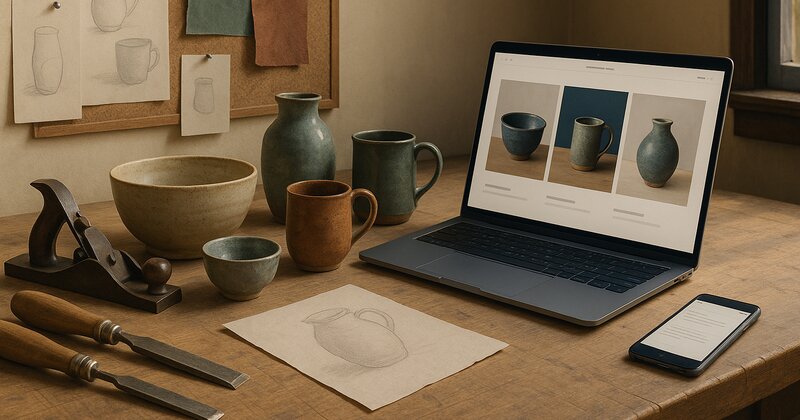
A Saxtons River potter sat in her studio in February 2026 and stared at a Shopify invoice: $468 for the year (Basic plan, $39/month). She sold nine pieces online in 2025. Nine. Total online revenue: $1,240. Shopify took $468 in subscription fees plus 2.9% + 30¢ per transaction (another $42 in payment processing fees). Her net online revenue after platform costs: $730. She spent 18 hours over the year photographing products, writing descriptions, managing inventory, processing orders, answering "when will this ship?" emails, and troubleshooting a theme update that broke her checkout page in November.
She calculated her effective hourly rate for e-commerce: $730 ÷ 18 hours = $40/hour. That sounds reasonable until you realize she makes $85 to $120/hour selling directly at her studio, at regional craft fairs (Brattleboro Winter Farmer's Market, Springfield Art & Craft Show), and through wholesale partnerships with three southern Vermont shops (one in Bellows Falls, one in Grafton, one in Woodstock). E-commerce was her lowest-margin, highest-effort sales channel. And yet she kept paying Shopify every month because she believed she "needed" e-commerce to be taken seriously as a professional artist.
She Googled "do artists need e-commerce" and found a hundred blog posts saying "yes, you must sell online to reach customers beyond your local area" and "e-commerce is the future of art sales." She asked ChatGPT "do I need e-commerce for my pottery business." ChatGPT said "e-commerce can expand your reach and allow customers to purchase anytime, but it depends on your audience and sales model." Unhelpful. She wanted a clear answer: do I need a shopping cart, or can I survive (and thrive) with just a portfolio site that shows my work, tells my story, and directs people to contact me or visit my studio?
The answer for most Saxtons River (and southern Vermont) artists, makers, and creative professionals is: you do not need e-commerce. You need a fast, beautiful portfolio site that shows your best work, explains your process, lists your studio hours or where to find you, and makes it easy for people to contact you. E-commerce makes sense for a small subset of creative businesses (high-volume product makers, artists selling prints or reproductions, makers with flat-rate shipping and consistent inventory). For everyone else (custom furniture builders, fine artists selling one-of-a-kind pieces, potters who prefer in-person sales, jewelry makers who do commissions), e-commerce adds cost, complexity, and low-margin busywork without meaningful revenue.
This post explains why portfolio sites (not e-commerce) are the right choice for most Saxtons River creative professionals, what a good portfolio site includes (your best work, your story, contact info, studio location, where else people can find you), when e-commerce actually makes sense (and when it does not), how to drive in-person sales and commissions from a portfolio site without a shopping cart, and why Google and AI tools cite portfolio sites just as well (or better) than e-commerce sites if you optimize correctly.
Why most Saxtons River artists and makers do not need e-commerce (and what they need instead)
E-commerce sounds like the obvious solution. You make things. People want to buy things. Put the things online with a "buy now" button. Revenue flows in while you sleep. Except it does not work that way for most creative professionals. Here is why:
You sell one-of-a-kind or custom work (not mass-produced inventory)
If you are a fine artist painting landscapes, a furniture maker building custom tables, a jeweler doing bespoke commissions, or a potter making unique pieces (not production runs of identical mugs), e-commerce is a poor fit. E-commerce works best for standardized inventory (you have 50 identical items in stock, a customer orders one, you ship it). E-commerce breaks down when every piece is different (a customer sees a painting online, wants to buy it, but you already sold it at a craft fair last week and forgot to mark it sold on your site). Custom work is even worse (a customer sees a table you built, wants one "just like it but with walnut instead of cherry and two feet longer," and expects to order and pay online, but your process requires conversation, design consultation, and a deposit before you start building).
A Saxtons River furniture maker tried Shopify in 2023. He posted photos of six tables, four benches, and two cabinets he had built (all custom, already sold to clients). He added "contact for custom orders" buttons instead of "add to cart." Shopify charged him $39/month. Over a year: $468. He got 12 inquiries via the Shopify contact form. Eight led to conversations. Three led to commissions. Total commissioned work revenue from the site: $14,000 (three projects averaging $4,500 each). But the Shopify site did not close the sales. The site generated the leads. The sales happened via phone, email, studio visits, sketches, quotes, and deposits (all outside Shopify). He could have done the same thing with a $0/month portfolio site with a contact form. The Shopify subscription added no value.
He switched to a simple custom-coded portfolio site in 2024. Cost: $0 upfront, $250/month subscription (hosting, updates, support included). The portfolio site had six pages: homepage (photos of his best pieces, a short bio, "contact to discuss your project"), gallery (20 photos of past work organized by type - tables, benches, cabinets, desks), process (step-by-step photos showing how he builds a table, from lumber selection to finishing), contact (email, phone, studio address in Saxtons River, availability, "commissions typically book 6 to 10 weeks out"), about (his story, his training, why he works in southern Vermont), and where to see his work (listed three shops that carry smaller items like cutting boards and picture frames, plus two annual craft fairs).
The portfolio site generated 18 inquiries in 2024 (up from 12 via Shopify in 2023). Ten led to conversations. Five led to commissions. Total commissioned work revenue: $22,000 (five projects averaging $4,400 each). The inquiries were better quality (people who understood custom work takes time and costs more than IKEA furniture). The site cost $3,000/year ($250/month × 12). Net revenue after site cost: $19,000. Compare to Shopify: $14,000 revenue minus $468 = $13,532 net. The portfolio site delivered 40% more net revenue and required less maintenance (no inventory management, no shipping setup, no payment processing troubleshooting).
Your margins are too thin to absorb e-commerce costs (platform fees, payment processing, shipping)
E-commerce costs eat 8% to 15% of revenue before you even account for your time. Here is the breakdown:
- Platform subscription: Shopify $39/month ($468/year), Squarespace Commerce $23/month ($276/year), WooCommerce plugins and hosting $15 to $40/month ($180 to $480/year).
- Payment processing: 2.9% + 30¢ per transaction (Shopify Payments, Stripe, Square), or 3.5% to 4% (PayPal). On a $100 sale, you pay $3.20 to $4.00.
- Shipping: USPS, UPS, FedEx rates vary wildly depending on size, weight, and distance. A 10-pound box from Vermont to California costs $15 to $25. You either charge the customer (which reduces conversions, because customers hate surprise shipping costs) or you eat the cost (which reduces your margin).
- Time: Product photography (30 to 60 minutes per product), writing descriptions (15 to 30 minutes per product), managing inventory (updating sold items, marking new items available), processing orders (printing packing slips, packing boxes, driving to the post office, tracking shipments), answering customer emails ("when will this ship?" "can I change my order?" "this arrived damaged, can I return it?").
If you sell a $150 handmade bowl via e-commerce, here is what you keep:
- Sale price: $150
- Payment processing (2.9% + $0.30): $4.65
- Platform fee (Shopify $39/month ÷ let's say 5 sales/month): $7.80 per sale
- Shipping (you charged $12, actual cost $15): -$3.00 (you ate $3)
- Packing materials (box, bubble wrap, tape, label): $2.50
- Your time (photography, listing, processing, packing, shipping: 90 minutes at $50/hour): $75
Net after costs: $150 - $4.65 - $7.80 - $3.00 - $2.50 - $75 = $57.05
You made $57 on a $150 sale. That is a 38% margin. Compare this to selling the same bowl at your studio or a craft fair:
- Sale price: $150
- Payment processing (Square reader, 2.6% + $0.10 if card, or $0 if cash): $4.00 or $0
- Your time (conversation with customer, wrapping the bowl in newspaper, putting it in a bag: 10 minutes at $50/hour): $8.33
Net after costs: $150 - $4.00 - $8.33 = $137.67 (or $141.67 if cash)
You made $137 on a $150 sale. That is a 92% margin. E-commerce cut your margin by more than half. For low-margin creative work (pottery, textiles, prints), e-commerce is not sustainable unless you have very high volume (50+ sales per month) and you optimize ruthlessly (no custom work, standardized products, flat-rate shipping, batch processing).
A Saxtons River textile artist sold hand-dyed scarves and shawls. She tried Etsy (cheaper than Shopify, but similar structure: listing fees, transaction fees, payment processing fees). In 2024, she sold 32 scarves online via Etsy. Average sale price: $68. Total online revenue: $2,176.
Etsy costs: $0.20 per listing × 15 active listings × 4 re-listings over the year (Etsy listings expire after 4 months) = $12 in listing fees. Transaction fee: 6.5% of $2,176 = $141.44. Payment processing: 3% + $0.25 per transaction, 32 transactions = $65.28 + $8.00 = $73.28. Shipping (she charged customers actual cost via Etsy's shipping calculator, so no loss there, but she spent $45 on packing materials). Total Etsy costs: $271.72.
Her time: 60 hours over the year (photography, listing, updating inventory, answering questions, packing and shipping, driving to the post office twice per week during busy months). At $50/hour (her target rate based on in-person sales): $3,000 in time cost.
Net after costs: $2,176 - $271.72 - $3,000 = -$1,095.72
She lost money on Etsy. Her online sales did not cover the platform costs and her time. Meanwhile, she sold 140 scarves in person (studio, craft fairs, wholesale to two shops) for $9,520 total revenue, with minimal processing costs (Square fees ~$250, craft fair booth fees $400, her time at fairs ~40 hours = $2,000). Net from in-person sales: $6,870. E-commerce was a money-losing distraction.
She closed her Etsy shop in late 2024 and built a portfolio site instead. The site showed photos of 20 scarves and shawls (her best work, beautifully photographed against southern Vermont landscapes - a covered bridge in Saxtons River, a stone wall in Grafton, fall leaves). The site explained her process (natural dyes from plants she forages locally, hand-weaving on a floor loom). The site listed where people could see and buy her work in person (her studio by appointment, three craft fairs per year, two retail shops carrying her work). The site had a contact form ("interested in commissioning a custom piece or scheduling a studio visit? Get in touch").
In 2025, the portfolio site generated 22 inquiries. Fifteen led to studio visits. Eight led to commissioned scarves or custom-dyed shawls (customers chose colors, fibers, dimensions). Total commissioned work revenue: $3,400 (eight commissions averaging $425 each, higher price point than her standard scarves because custom work is worth more). The site cost $275/month ($3,300/year). Net after site cost: $100. Still barely break-even, but the commissions opened a higher-margin revenue stream (custom work at premium prices) that she had not tapped before. And the site required far less time (no inventory management, no packing and shipping, no Etsy fees and policies to navigate).
E-commerce does not build relationships (and relationships are how most creative professionals get repeat customers and referrals)
Art and craft sales are relationship-driven. Customers buy from you because they met you at a craft fair, visited your studio, heard your story, saw your process, or were referred by a friend who loves your work. E-commerce removes the relationship. A customer clicks "buy now," receives a box in the mail, and moves on. No conversation. No story. No connection. They are less likely to return, less likely to refer you, and less likely to pay premium prices for custom work.
A portfolio site preserves the relationship. A customer finds your site, sees your work, reads your story, and contacts you. You reply. You have a conversation. They visit your studio or meet you at a craft fair. They see your workspace, watch you throw a pot or cut a dovetail, ask questions, understand why your work costs what it costs. They buy a piece, and they remember you. They come back next year. They refer their friends. They commission custom work. The relationship drives lifetime value, not one-time transactions.
A Saxtons River jeweler built a Shopify site in 2022. She sold 14 pieces online over two years. Total revenue: $1,820. None of those 14 customers bought again. None referred anyone. The transactions were transactional (click, pay, receive package, done).
In 2024, she closed the Shopify site and built a portfolio site. The site showed 30 pieces (rings, necklaces, earrings, bracelets) with detailed photos and descriptions (materials, inspiration, how each piece was made). The site had a page about her process (hand-forging, stone-setting, finishing). The site listed studio hours (Thursdays and Saturdays, 12pm to 5pm, by appointment) and three retail partners carrying her work. The site had a contact form for commissions ("engagement rings, custom designs, repairs, and restorations welcome").
In 2025, the portfolio site generated 31 inquiries. Twenty-three led to studio visits or phone consultations. Twelve led to sales (six ready-made pieces purchased at the studio, six custom commissions). Total revenue: $8,400 (twelve sales averaging $700 each, higher average than online sales because custom work commands premium pricing). Eight of the twelve customers were referrals (friends or family of past customers who had visited the studio and loved the experience). Four customers returned within the year to buy gifts or commission additional pieces. The lifetime value of those twelve customers (based on repeat purchases and referrals) was easily $15,000 to $20,000 over two to three years. The Shopify customers (one-time transactions, no relationship) had zero lifetime value beyond the initial $130 average sale.
The portfolio site cost $250/month ($3,000/year). Net revenue after site cost: $5,400. Compare to Shopify: $1,820 revenue over two years ($910/year average) minus $468/year = $442/year net. The portfolio site delivered 12x the annual net revenue and built a customer base with long-term value.
What a good portfolio site includes (and what it does not need)
A portfolio site is not a stripped-down version of an e-commerce site. It is a different tool with a different purpose. E-commerce sites are optimized for transactions (fast checkout, inventory management, shipping calculators). Portfolio sites are optimized for storytelling, credibility, and driving contact (your best work, your process, how to reach you).
Here is what a good portfolio site for Saxtons River artists and makers includes:
Your best work, beautifully photographed (10 to 30 pieces, not your entire catalog)
Show 10 to 30 pieces that represent your range, your skill, and your aesthetic. Do not post every piece you have ever made. Curate. Choose pieces that photograph well, tell a story, or demonstrate technique. Include 2 to 4 photos per piece (overview, detail shots, scale or context shots showing the piece in use or in a real setting).
Photograph in natural light if possible. Southern Vermont has excellent light (soft, diffused, especially in morning or late afternoon). Shoot against clean backgrounds (white walls, neutral fabric, or southern Vermont landscapes if the piece fits the context - a wooden bowl on a stone wall, a textile draped over a fence rail, a piece of furniture in a restored barn).
Do not use phone photos shot in bad light with cluttered backgrounds. Invest 4 to 8 hours (or hire a photographer for $300 to $800) to get 30 to 50 high-quality images you can use for years. Good photos make your work look professional and worth the price. Bad photos make your work look amateur and cheap, even if the work itself is excellent.
A Saxtons River woodworker had a portfolio site with 40 photos of past work. Half were phone photos shot in his dimly lit workshop (poor lighting, cluttered background, tools and sawdust visible in the frame). The other half were high-quality photos shot outside in natural light (clean, crisp, the grain and joinery clearly visible). When he asked three potential clients for feedback ("why did you choose my competitor instead of me?"), two said "your work looked good, but the photos made it hard to judge quality."
He hired a local photographer in 2025 (Bellows Falls, $500 for a half-day shoot). They photographed 15 pieces (tables, benches, desks, cabinets) outside on a sunny April morning (blue sky, budding trees, the Connecticut River visible in the background of a few shots). The photographer delivered 60 edited images. The woodworker replaced the old phone photos on his site with the new professional photos. He updated his portfolio page to show 20 pieces (the best 15 newly photographed pieces plus 5 older pieces with decent photos).
Three months later, he tracked inquiries. Before new photos (January to March 2025): 6 inquiries, 1 commission. After new photos (April to June 2025): 14 inquiries, 5 commissions. He attributed the increase to the photos ("clients told me the new photos made the quality and craftsmanship obvious - they could see the joinery, the wood grain, the scale"). The $500 photography investment generated 4 additional commissions in three months (net revenue after materials and time: ~$12,000). ROI in the first month.
Your story and process (why you do this work, how you do it, what makes your approach different)
Customers do not just buy objects. They buy stories. They want to know why you became a potter, where you learned furniture making, what inspires your textile designs, how you source materials. They want to understand your process (throwing on the wheel, carving, dyeing, joinery, finishing). They want to know what makes your work different (hand-forged vs. cast, natural dyes vs. synthetic, locally sourced lumber vs. imported, one-of-a-kind vs. production runs).
Write 200 to 400 words about your story. Keep it conversational (write like you would talk to a customer visiting your studio). Include specifics (where you trained, how long you have been working, what materials you prefer, what you are working on now). Avoid generic artist statements ("I explore the intersection of form and function" or "my work challenges traditional boundaries"). Be concrete ("I learned woodworking from my grandfather, a boat builder in Maine. I moved to Saxtons River in 2018 and set up a shop in a restored mill building. I work mostly with locally sourced hardwoods - cherry, walnut, maple, ash - from a sawmill in Springfield. Each piece is hand-cut, hand-planed, and finished with linseed oil and beeswax.").
Write 200 to 400 words about your process. Include step-by-step photos (a piece in progress - rough-sawn lumber, glue-up, sanding, finishing). Explain your choices ("I use mortise-and-tenon joinery instead of screws or dowels because it is stronger and more beautiful" or "I dye with plants I forage locally - goldenrod for yellow, black walnut hulls for brown, madder root for red"). Process stories build credibility and justify pricing (customers understand why your table costs $3,000 when they see the 40 hours of handwork that went into it).
A Saxtons River painter had a portfolio site with beautiful images of her landscapes but no story or process. Her about page said: "I am a Vermont-based painter working in oils and acrylics." That was it. Her inquiries were sparse (12 per year). When she asked a few contacts why they did not commission a painting, one said "I loved your work, but I did not feel like I knew you or understood your approach. I ended up hiring an artist whose site explained her process and her connection to Vermont landscapes."
She rewrote her about page in 2025. New version (350 words):
I have been painting southern Vermont landscapes for 18 years. I grew up in Saxtons River, left for art school in Boston (MassArt, BFA 2005), and returned in 2007 when I realized the landscapes I kept painting from memory were all within ten miles of my childhood home.
I work primarily in oils, painting en plein air (outdoors, on location) during warm months and from sketches and photos in my studio during winter. My subjects are the places most people drive past without noticing: dirt roads in Grafton, beaver ponds in Cambridgebridge, stone walls half-buried in brambles, barns leaning into hillsides. I am interested in the quiet, in-between places that define rural Vermont but do not make it onto postcards.
I paint on-site because the light changes everything. A hillside at 7am in October (cool light, long shadows, frost on the grass) is a different painting than the same hillside at 4pm (warm light, short shadows, no frost). I work fast - most pieces take two to four hours on location, then another six to ten hours in the studio (refining edges, adjusting values, adding detail).
I show work at two galleries (one in Bellows Falls, one in Woodstock) and my studio in Saxtons River (open by appointment). I take commissions for specific locations (your family's farm, your favorite hiking trail, the view from your porch). Most commissioned pieces take four to six weeks from initial conversation to delivery.
She added a process page with 12 photos: her painting outdoors (easel set up in a field, brush in hand, the landscape in progress), close-ups of brush strokes and palette, a finished painting next to a photo of the actual location, her studio (north-facing windows, stacks of canvases, a wall of paint tubes).
Six months later (January to June 2025), her inquiries increased from 6 (same period in 2024) to 19. Eleven led to conversations. Four led to commissions. Total commissioned work revenue: $6,800 (four paintings averaging $1,700 each). She attributed the increase to the story and process pages ("clients told me they felt like they knew me before they reached out, and they trusted me to capture a place that mattered to them").
Contact information and how to see or buy your work (studio hours, craft fairs, retail partners)
Make it obvious how people can reach you (email, phone, contact form). List your studio address and hours if you welcome visitors (many Saxtons River artists work out of home studios or shared spaces and are happy to host visits by appointment). If you do not want studio visits, list where people can see your work (craft fairs, galleries, retail partners).
Be specific. Do not just say "available at select retailers." List the actual shops ("my pottery is available at [Shop Name] in Bellows Falls, [Shop Name] in Grafton, and [Shop Name] in Woodstock"). Link to the shops' websites if they have them. List craft fairs by name and date ("I show work at the Brattleboro Winter Farmer's Market, Saturdays 10am to 2pm, November through March, and the Springfield Art & Craft Show, first Saturday in June").
Include a contact form or email address for commissions, studio visits, or questions. Respond within 24 hours (or set expectations - "I typically reply within 48 hours"). Fast response builds trust. Slow response (or no response) makes customers assume you are not professional or not interested.
A Saxtons River ceramicist had a portfolio site with stunning photos of her functional pottery (bowls, mugs, plates, vases) but no contact information visible. Her email address was hidden in an image (to avoid spam bots). Her phone number was not listed. Her studio location was vague ("Saxtons River area"). She mentioned she sold at craft fairs but did not list which fairs or when.
Her inquiries were low (8 in 2024). When she surveyed a few friends ("would you contact me based on this site?"), three said "I loved your work, but I did not know how to reach you. I clicked around looking for an email address and gave up."
She redesigned her contact page in early 2025. New version:
Get in touch
Interested in visiting my studio, commissioning a custom piece, or asking about available work? I would love to hear from you.Email: [email]
Phone: [phone number]
Studio visits: By appointment, Thursdays and Saturdays, 10am to 4pm. My studio is in Saxtons River (exact address provided when you schedule a visit).Where to see my work:
- [Shop Name], Bellows Falls VT (functional pottery - bowls, mugs, plates)
- [Shop Name], Grafton VT (vases and decorative pieces)
- Brattleboro Winter Farmer's Market, Saturdays 10am to 2pm, November through March
- Springfield Art & Craft Show, first Saturday in June
- Vermont Hand Crafters Holiday Market, Montpelier, second weekend in December
Commissions: I take commissions for dinnerware sets, custom glaze colors, and one-of-a-kind pieces. Lead time is typically 6 to 8 weeks. Contact me to discuss your project.
[Contact form: name, email, phone, message]
She also added her email and phone number to the footer of every page (so visitors could contact her from any page, not just the contact page).
Six months later (January to June 2025), inquiries increased from 4 (same period in 2024) to 17. Thirteen led to studio visits or phone calls. Seven led to sales (three dinnerware sets commissioned, four individual pieces purchased at the studio). Total revenue: $4,100. She attributed the increase to clarity ("people told me they appreciated knowing exactly how to reach me and when they could visit my studio").
Schema markup (so Google and AI tools understand who you are and what you do)
Schema markup is structured data (invisible code on your website) that tells Google, ChatGPT, and Perplexity exactly what your business is, what you offer, where you are located, and how to contact you. Schema is critical for local search rankings and AI citations. A portfolio site with no schema ranks lower and gets cited less than a portfolio site with detailed schema.
For creative professionals, use VisualArtist or LocalBusiness schema (depending on your work). Include properties like:
- name: Your name or business name.
- url: Your website URL.
- address: Your studio address (or city/town if you do not want to list a street address).
- telephone: Your phone number.
- email: Your email address.
- openingHours: Your studio hours if you have them (e.g., "Th-Sa 10:00-16:00 by appointment").
- areaServed: List towns or regions you serve (Saxtons River, Bellows Falls, Grafton, southern Vermont).
- makesOffer: List what you offer (custom furniture, commissioned paintings, pottery, jewelry, textiles).
- knowsAbout: List your skills or specialties (woodworking, oil painting, hand-forging, natural dyeing).
- sameAs: Link to your social media profiles (Instagram, Facebook) if you have them.
Schema takes 30 to 90 minutes to write and add to your site (a developer can do this for $200 to $400, or you can use a schema generator tool and add it yourself if you have access to your site's code). The ROI is immediate (Google ranks you higher, AI tools cite you more often).
A Saxtons River fine artist had a portfolio site with no schema. When she Googled "artist Saxtons River VT," her site ranked fifth (below three competitors with schema and one directory listing). When she asked ChatGPT "who is a good landscape painter in southern Vermont," she was not cited (ChatGPT cited three artists with schema markup).
She hired a developer to add VisualArtist schema in early 2025. The schema included her name, url, telephone, email, studio address (Saxtons River, VT), areaServed ("southern Vermont, including Bellows Falls, Grafton, Westminster, Townshend"), makesOffer ("commissioned landscape paintings, plein air paintings, studio paintings, custom sizes and subjects available"), knowsAbout ("oil painting, plein air painting, Vermont landscapes, rural scenes"), and links to her Instagram and Facebook. The developer also added ImageObject schema for 20 paintings (title, description, date created, medium, dimensions, price range).
Two weeks later, she Googled "artist Saxtons River VT" and ranked second (up from fifth). She Googled "landscape painter southern Vermont" and ranked fourth. She asked ChatGPT "who is a good landscape painter in southern Vermont" and was cited (ChatGPT pulled her name, studio location, and description of her work from the schema). She asked Perplexity "where can I commission a painting in southern Vermont" and was cited (Perplexity pulled her contact info and makesOffer data from the schema).
Over the next three months (February to April 2025), inquiries increased from 5 (same period in 2024) to 14. Ten led to conversations. Three led to commissions. Total commissioned work revenue: $5,100 (three paintings averaging $1,700 each). She attributed the increase to schema ("I showed up in searches and AI recommendations I never appeared in before").
When e-commerce actually makes sense (and how to know if you are the exception)
E-commerce is not wrong for every creative professional. It works well for a specific subset of makers. Here is when e-commerce makes sense:
You sell standardized products with consistent inventory (prints, production pottery, small goods)
If you make 50 identical coffee mugs, 100 identical prints, or 30 identical pairs of earrings, e-commerce works. You photograph one mug, list it with quantity = 50, and customers order. When someone buys a mug, inventory decrements to 49. You pack and ship. Repeat. Standardized inventory fits e-commerce logic.
A Saxtons River printmaker sells limited-edition prints (10 to 25 copies per image). She photographs one print, lists it on her Shopify site with quantity = 25, prices it at $45, and sets flat-rate shipping ($6 USPS First Class). When someone orders, she prints a packing slip, slides the print into a cardboard mailer, tapes it shut, prints a shipping label, and drops it at the post office. Total time: 8 minutes per order. She processes 6 to 10 orders per week (250 to 400 per year). E-commerce works because the product is standardized (same size, same packaging, same shipping cost), inventory is clear (she knows how many copies are left), and processing is fast (8 minutes per order is sustainable at this volume).
Her 2024 online revenue: $16,000 (380 prints sold at $42 average after discounts). Shopify cost: $468. Payment processing: ~$530 (2.9% + $0.30 per transaction). Shipping (she charged $6, actual cost averaged $5.20): +$304 profit. Packing materials: $400. Time: 50 hours (380 orders × 8 minutes = 50 hours). At $50/hour: $2,500.
Net after costs: $16,000 - $468 - $530 + $304 - $400 - $2,500 = $12,406.
That is a 77% margin. E-commerce works for her because she has volume (380 orders), standardized products (same print size and packaging), and reasonable time investment (50 hours per year is manageable).
If she sold one-of-a-kind paintings instead of prints, e-commerce would not work (she cannot list "quantity = 1" for every painting, and customers cannot compare identical items and choose based on price). If she sold custom prints (where customers request specific crops, sizes, or framing), e-commerce would not work (too much conversation and back-and-forth for an automated checkout flow). But for standardized, production-run prints, e-commerce makes sense.
Your shipping costs are predictable and low (flat-rate USPS, lightweight items)
E-commerce works well when shipping is cheap and predictable (small, lightweight items that fit in USPS flat-rate envelopes or boxes). If you sell jewelry, prints, scarves, or small ceramics (mugs, bowls), you can charge $6 to $12 flat-rate shipping and cover your costs. Customers accept flat-rate shipping for small items.
E-commerce breaks down when shipping is expensive and variable (large furniture, heavy pottery, fragile sculptures). A coffee table costs $80 to $150 to ship (UPS or freight, depending on distance). Customers balk at $150 shipping on a $600 table (25% of the price). If you offer "free shipping," you eat the $150 cost, which destroys your margin. If you use a shipping calculator (customer enters their ZIP code, you calculate actual cost), customers see "$127 shipping" and abandon the cart. Furniture and large items should not be sold via e-commerce (better to sell locally or arrange in-person delivery, or charge a flat regional delivery fee if you are within 30 to 50 miles).
A Saxtons River jeweler sells earrings, necklaces, and bracelets ($40 to $180 per piece). Average weight: 2 to 4 ounces. She ships via USPS First Class in a padded envelope ($4 to $5). She charges customers $6 flat-rate shipping. Shipping profit: $1 to $2 per order. E-commerce works because shipping is cheap, predictable, and customers accept the cost.
A Saxtons River potter sells large serving bowls and vases ($80 to $220 per piece). Average weight: 3 to 6 pounds. Shipping (USPS Priority Mail, well-padded box): $15 to $22 depending on distance. She tried charging actual shipping cost via a Shopify calculator. Cart abandonment rate: 65% (customers added a bowl to their cart, saw "$18 shipping," and left). She tried offering free shipping over $100. She sold 8 bowls in two months, ate $140 in shipping costs, and made almost no profit. E-commerce does not work for large, heavy pottery (better to sell at craft fairs, in-studio, or through retail partners who handle shipping or local pickup).
You have volume (50+ orders per month) and you optimize for efficiency
E-commerce works at scale. If you sell 50+ items per month, the time investment (processing orders, packing, shipping) is still significant (50 orders × 10 minutes = 8 hours per month), but the platform costs become negligible per order (Shopify $39/month ÷ 50 orders = $0.78 per order). If you optimize (batch processing - pack 20 orders in one session, print 20 labels at once, make one post office trip per week), you reduce time per order.
If you sell fewer than 10 items per month, e-commerce costs are brutal (Shopify $39/month ÷ 5 orders = $7.80 per order, plus $3 to $5 payment processing, plus $2 to $5 shipping overhead, plus 30 to 60 minutes of your time per order = you are losing money on every sale).
A Saxtons River soapmaker sells handmade soap bars (6 to 8 scents, $8 per bar, customers usually buy 3 to 6 bars per order). She sells via Shopify. In 2024, she processed 720 orders (60 per month average). Average order: 4 bars = $32. Revenue: $23,040. Shopify cost: $468. Payment processing (2.9% + $0.30 per order): ~$760. Shipping (flat rate $5, actual cost $4.20): +$576 profit. Packing materials: $600. Time: 120 hours (720 orders × 10 minutes = 120 hours). At $50/hour: $6,000.
Net after costs: $23,040 - $468 - $760 + $576 - $600 - $6,000 = $15,788.
That is a 68% margin. E-commerce works because she has volume (60 orders per month), standardized products (same bars, same packaging), low shipping costs (soap is light), and she batch-processes (makes 200 bars at a time, packs 20 orders per session). If she sold 10 orders per month instead of 60, her margin would drop to 25% to 30% (platform and time costs would eat most of the profit).
You sell to customers outside your region (and you have no local sales channels)
If you live in a remote area with no local customer base, no craft fairs within 50 miles, and no retail partners willing to carry your work, e-commerce may be your only option. But this is rare in southern Vermont. Saxtons River, Bellows Falls, Grafton, Brattleboro, and Townshend all have active craft fairs, local shops carrying Vermont-made goods, and tourist foot traffic. Most Saxtons River makers can sell locally (studio, fairs, wholesale) and regionally (tourists, second-home owners, day-trippers from Massachusetts, Connecticut, New York).
If you are making work that appeals to a national or international audience (very specific niche - e.g., reproduction Colonial furniture, rare book restoration, scientific glassblowing), e-commerce makes sense because your local market is too small. But most Saxtons River artists and makers are making work with broad appeal (functional pottery, landscape paintings, furniture, textiles, jewelry). That work sells well locally and regionally. You do not need e-commerce to reach customers. You need good local marketing (portfolio site, Google Business Profile, craft fairs, partnerships with local shops, word-of-mouth).
A Saxtons River blacksmith makes custom fireplace tools, hinges, and decorative ironwork. His work appeals to a niche audience (historic home restorers, high-end builders, people building timber-frame houses or restoring Colonial homes). His local market (Saxtons River and surrounding towns) is small (maybe 5 to 10 projects per year). He tried selling via Etsy and his own e-commerce site in 2022-2023. He sold 6 pieces online over two years (total revenue $2,400). Shipping was brutal (fireplace tools weigh 15 to 30 pounds, shipping cost $25 to $50 per order, customers balked). He spent 40 hours over two years managing the online store.
He closed the online store in 2024 and focused on regional partnerships (architect and builder referrals, historical society connections, timber-frame companies in Vermont and New Hampshire). He built a portfolio site showing 25 pieces (photos of finished work installed in homes, close-ups of joinery and forging details, a process page showing him at the forge). The site had no e-commerce. It had a contact form and a note: "custom ironwork for historic homes, timber-frame builds, and architectural restoration. Lead time typically 8 to 12 weeks. Contact to discuss your project."
In 2024-2025, he got 14 inquiries via the portfolio site. Ten led to conversations. Six led to commissioned projects (two fireplace tool sets, three hinge sets for historic doors, one custom railing). Total commissioned work revenue: $18,000 (six projects averaging $3,000 each, much higher than his Etsy sales because custom architectural ironwork commands premium pricing). The portfolio site cost $275/month ($3,300/year). Net revenue after site cost: $14,700. Compare to Etsy: $2,400 revenue over two years ($1,200/year average) minus Etsy fees (~$200/year) = $1,000/year net. The portfolio site delivered 15x the annual net revenue by focusing on regional partnerships and commissions (not e-commerce).
How to drive in-person sales and commissions from a portfolio site (without a shopping cart)
A portfolio site is not passive. It does not generate revenue while you sleep (like e-commerce promises to do, though it rarely delivers). A portfolio site is active: it drives inquiries, conversations, studio visits, and commissions. Here is how to use a portfolio site to generate revenue:
Optimize for local search ("artist Saxtons River VT," "furniture maker southern Vermont," "potter near Bellows Falls")
Your portfolio site should rank well for local search queries (people searching for artists or makers in your town or region). Optimize your homepage and about page with local keywords:
- Homepage headline: "Custom furniture maker in Saxtons River, Vermont" or "Landscape painter - southern Vermont" or "Hand-forged jewelry - Saxtons River studio."
- Homepage body text: Mention your town, nearby towns, and region multiple times (naturally, not keyword-stuffed). Example: "I build custom tables, desks, and cabinets in my Saxtons River workshop, serving clients in Bellows Falls, Grafton, Westminster, and throughout southern Vermont."
- About page: Mention where you trained, where you moved from, why you work in southern Vermont, what materials you source locally. Example: "I moved to Saxtons River in 2015, drawn by the rural landscape and the community of makers in the Bellows Falls and Grafton area."
- Schema: Add address (or addressLocality: "Saxtons River, VT"), areaServed (list towns you serve or where customers come from), and knowsAbout (your skills and specialties).
When a traveler or second-home owner Googles "potter Saxtons River VT" or "custom furniture southern Vermont," your site should appear in the top three results. If you do not rank, you miss inquiries. Local SEO for creative professionals is low-competition (most artists and makers have no website or a poorly optimized site). If you optimize even minimally, you will rank well.
A Saxtons River weaver had a portfolio site with beautiful photos of her rugs and wall hangings but no local keywords. Her homepage said: "Handwoven textiles." Her about page said: "I weave rugs and wall hangings using natural fibers." No mention of Saxtons River, southern Vermont, or nearby towns. When she Googled "weaver southern Vermont," her site did not appear in the top ten results. When she Googled "textile artist Saxtons River," her site ranked sixth (below directory listings and competitors in Brattleboro and Putney with better local SEO).
She rewrote her homepage and about page in early 2025. New homepage headline: "Handwoven rugs and wall hangings - Saxtons River, Vermont." New homepage body text: "I weave one-of-a-kind rugs and wall hangings in my Saxtons River studio, using wool, linen, and cotton sourced from Vermont and New England mills. My work is available at galleries in Bellows Falls and Grafton, and through commissions for clients throughout southern Vermont." She added schema with addressLocality: "Saxtons River, VT" and areaServed: ["Saxtons River", "Bellows Falls", "Grafton", "Townshend", "Westminster", "southern Vermont"].
Two weeks later, she Googled "weaver southern Vermont" and ranked third (up from not visible). She Googled "textile artist Saxtons River" and ranked first. Over the next three months (February to April 2025), inquiries increased from 3 (same period in 2024) to 11. Seven led to studio visits. Three led to commissions (two custom rugs, one large wall hanging). Total commissioned work revenue: $4,200 (three commissions averaging $1,400 each). She attributed the increase to local SEO ("people told me they Googled 'weaver near Bellows Falls' or 'textile artist southern Vermont' and found me").
Get cited by AI tools (ChatGPT, Perplexity, Google AI Overviews)
When travelers or locals ask ChatGPT or Perplexity "who is a good furniture maker in southern Vermont" or "where can I buy handmade pottery near Saxtons River," you want to be cited. AI citations drive high-intent inquiries (people asking AI are actively looking for something, not just browsing).
AI tools cite businesses with complete schema, complete Google Business Profiles, and external citations (mentions on directories, blogs, galleries, or retail partner sites). Here is how to get cited:
- Add schema (as described above).
- Claim and complete your Google Business Profile (photos, description, hours, services, attributes).
- Get listed on VisitVermont.com and regional directories (southern Vermont arts directories, chamber directories, gallery sites if you show work there).
- Get mentioned on retail partner sites (if a Bellows Falls shop carries your pottery, ask them to link to your portfolio site from their site or list you as a "featured maker").
- Write clear, answer-friendly content (your about page should answer "who are you?" and "what do you make?" in plain language, not abstract artist statements).
A Saxtons River furniture maker added schema and optimized his Google Business Profile in late 2024. He also got listed on two directories (southern Vermont makers directory, Bellows Falls area chamber directory) and asked a Grafton shop that carried his cutting boards to mention him on their site ("custom furniture by [name], studio in Saxtons River, commissions available").
Two weeks after the schema and citations went live, he tested ChatGPT: "who is a good custom furniture maker in southern Vermont?" ChatGPT cited him (pulled his name, studio location, and description from schema and the Grafton shop mention). He tested Perplexity: "where can I commission a dining table near Bellows Falls VT?" Perplexity cited him (pulled his contact info and areaServed data from schema). Before schema and citations, neither tool mentioned him.
Over the next four months (January to April 2025), he tracked the source of inquiries (he asked every inquiry "how did you find me?"). Before optimization (same period in 2024): 9 inquiries total, sources: 4 word-of-mouth, 3 Google search, 2 saw work at a shop. After optimization: 16 inquiries total, sources: 5 word-of-mouth, 6 Google search, 3 AI tools (ChatGPT or Perplexity), 2 saw work at a shop. AI tool inquiries were new (he had zero in 2024). Six of the 16 inquiries led to commissions. Total commissioned work revenue: $21,000 (six projects averaging $3,500 each). He attributed at least two of the six commissions (maybe three) to AI citations.
Partner with local shops and galleries (wholesale, consignment, or commission splits)
If you make smaller, production-run items (mugs, bowls, prints, jewelry, textiles, cutting boards, small furniture), partner with local shops and galleries. Wholesale (you sell to the shop at 50% of retail, shop marks up and keeps the margin) or consignment (shop displays your work, takes 30% to 40% commission when it sells) or commission splits (shop takes 30% to 50% commission, you keep the rest).
List these partnerships on your portfolio site ("my pottery is available at [Shop Name] in Bellows Falls, [Shop Name] in Grafton, and [Shop Name] in Woodstock"). Link to the shops. This does three things: (1) gives customers multiple ways to see and buy your work without you processing every sale, (2) increases your credibility (being carried by established shops signals quality), and (3) creates external citations (shops often list you on their site or social media, which helps your local SEO and AI citations).
A Saxtons River potter partnered with three shops in 2024 (Bellows Falls, Grafton, Woodstock). She delivered 60 pieces over the year (mugs, bowls, plates, $18 to $45 retail). The shops sold 52 pieces. Total retail value: $1,560. Her wholesale revenue (50% of retail): $780. She listed the partnerships on her portfolio site. Over the year, 8 customers found her via the shop partnerships (they saw her work at a shop, asked the shopkeeper for her name, Googled her, found her portfolio site, and contacted her to commission custom work or visit her studio). Four of those 8 inquiries led to commissions (dinnerware sets, custom glaze colors). Total commissioned work revenue: $3,600 (four commissions averaging $900 each, higher margin than wholesale). The shop partnerships generated $780 in wholesale revenue plus $3,600 in commissioned work revenue = $4,380 total. The time investment: 20 hours over the year (making the 60 pieces, delivering them to shops, coordinating restocks).
She calculated ROI: $4,380 revenue ÷ 20 hours = $219/hour. Shop partnerships were her highest-margin sales channel (higher than craft fairs, higher than online sales, similar to in-studio sales but with less direct customer interaction required).
Show at craft fairs and mention them on your site (with dates and locations)
Craft fairs are high-value sales channels for makers (direct sales, immediate payment, no shipping, face-to-face customer relationships). List your craft fair schedule on your portfolio site. This does two things: (1) drives foot traffic to your booth (people find your site, see you will be at [fair name] on [date], and plan to visit), and (2) gives people who missed the fair a way to contact you ("I saw your work at the Springfield Art & Craft Show, can I visit your studio?").
Update your site after each fair with new photos (booth setup, customers looking at your work, sold pieces). Post on social media and link to your portfolio site. Cross-promote: your site drives fair attendance, your fair presence drives site visits and inquiries.
A Saxtons River jeweler shows work at four craft fairs per year (Brattleboro Winter Farmer's Market, Springfield Art & Craft Show, Vermont Hand Crafters Killington show, a Woodstock holiday market). She lists the fairs on her portfolio site with dates, locations, and links to fair websites. She updates the site one week before each fair with a note: "I will be at [fair name] this weekend, booth #[number], showing new spring collection - stop by!"
She tracked sales in 2024: $18,000 in direct sales at fairs (average $4,500 per fair). She also tracked post-fair inquiries (people who visited her booth, took her card, and contacted her later). In 2024, she got 19 post-fair inquiries (people emailed or called, mentioning "I met you at [fair name]"). Eleven led to studio visits or phone consultations. Five led to commissions (engagement rings, custom necklaces). Total commissioned work revenue from post-fair inquiries: $6,200 (five commissions averaging $1,240 each). The fairs generated $18,000 in direct sales plus $6,200 in follow-up commissions = $24,200 total. Her portfolio site was critical for follow-up (customers took her card, visited her site, saw her full portfolio and process, and felt confident commissioning custom work).
The bottom line: most Saxtons River artists and makers need a portfolio site, not e-commerce
E-commerce sounds appealing (passive income, sales while you sleep, reach customers anywhere). But for most creative professionals, e-commerce delivers low margins, high complexity, and minimal revenue. Portfolio sites deliver higher margins (no platform fees, no shipping overhead), simpler workflows (no inventory management, no order processing), and better customer relationships (inquiries lead to conversations, conversations lead to commissions and repeat business).
If you sell one-of-a-kind or custom work, your margins are too thin to absorb e-commerce costs, your customers want to meet you and see your work in person, or you sell fewer than 20 pieces per month online, skip e-commerce. Build a portfolio site instead. Show your best work, tell your story, optimize for local search and AI citations, and drive in-person sales and commissions.
The cost difference is significant. E-commerce (Shopify, Etsy, Squarespace Commerce) costs $300 to $600/year in platform fees, plus payment processing (3% to 6.5%), plus shipping overhead (3% to 10% of revenue), plus 50 to 150 hours per year managing inventory and processing orders. A portfolio site costs $2,500 to $4,000 one-time (or $200 to $300/month subscription), includes hosting and support, requires minimal ongoing time (update photos and text a few times per year), and drives higher-margin sales channels (studio visits, commissions, craft fairs, wholesale partnerships).
Saxtons River has a strong community of makers (woodworkers, potters, painters, jewelers, textile artists, blacksmiths, printmakers). Most have no website or a slow, outdated site. If you build a fast, beautiful portfolio site in 2026, you will dominate local search ("artist Saxtons River VT," "furniture maker southern Vermont," "potter near Bellows Falls") and AI recommendations ("who is a good painter in southern Vermont," "where can I commission custom furniture near Saxtons River"). You will capture inquiries from tourists, second-home owners, and locals who are searching online but cannot find you. You will build a customer base with long-term value (repeat commissions, referrals, collectors who follow your work over years).
The businesses that wait (or stay on Shopify or Etsy, bleeding money on platform fees and low-margin online sales) will watch inquiries and commissions flow to competitors with better online presence. The choice is clear: portfolio sites win for most creative professionals. E-commerce is for the rare exceptions (production makers with volume, standardized products, flat-rate shipping, and ruthless operational efficiency). Everyone else should build a portfolio site, optimize for local search and AI, and focus on the sales channels that actually work: studio, craft fairs, wholesale partnerships, and commissions.
Every custom site we build for Saxtons River and southern Vermont creative professionals includes fast loading speed (under 2 seconds, 90+ PageSpeed Insights scores), beautiful portfolio layouts optimized for visual work (large images, clean typography, mobile-friendly galleries), full schema markup (VisualArtist or LocalBusiness with detailed properties for local search and AI citations), contact forms and inquiry tracking (so you never miss a lead), and hosting and updates included (no surprise bills, no downtime). We show you examples of portfolio sites we have built for Vermont artists, furniture makers, and craftspeople with before-and-after ranking data and AI citation tests. If you are not sure whether your current site (or your Shopify or Etsy store) is costing you more than it is earning, the free 27-point local SEO audit includes a ranking test (we search your core queries and show you where you rank vs. competitors), a schema audit (we check whether your site has schema and what is missing), an AI citation test (we ask ChatGPT and Perplexity about your work and show you whether you are cited), and a cost-benefit analysis (we compare your current platform costs to a portfolio site and show you the ROI). We show you exactly what is missing, what it is costing you, and whether e-commerce or a portfolio site makes sense for your business. Check out what is included in a subscription site (portfolio site, hosting, schema, updates, support, all included for one predictable monthly cost) or start with the audit to see where you stand and what Saxtons River customers are finding instead of you.
Keep reading
How much does a website cost in West Dover, Vermont? (2026 honest breakdown)
DIY vs freelancer vs agency vs custom-coded: what drives the number in 2026, from $0 Wix sites to $15K agency builds, with no fluff and real tradeoffs for West Dover lodging, dining, and ski-season businesses.
How much does a website cost in Putney, Vermont? (2026 honest breakdown)
A Putney farm store owner got quotes from $800 to $9,000 for a website and had no idea which was fair. Here's what drives the number, what you get at each price tier, and what actually matters for a small business in 2026.
How much does a website cost in Wilmington, Vermont? (2026 honest breakdown)
A Wilmington restaurant paid $4,800 for a WordPress site that loaded in 7 seconds. A competitor paid $3,000 for a custom site that loaded in 1.8 seconds and ranked higher. Here's what actually drives website costs in 2026.